Despite its official atheism, the Chinese government does like some gods and goddesses. The ones that give it a means of infiltrating and, it hopes, subverting Taiwanese society.
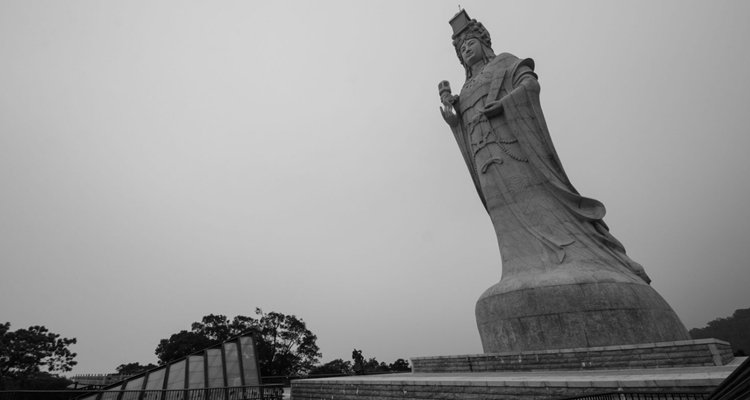
The Chinese Communist Party pretends to believe in reincarnation for at least as long as it takes to say that it’s only the Party, not any group of Tibetan monks, which, after the current Dalai Lama dies, will have the authority to determine who is the person in whom the Dalai Lama is being or has been reincarnated. Similarly, the CCP is all in favor of venerating “the goddess Mazu [depicted in the statue shown above], the divinized general Guan Yu, and other deities” that can be “mobilized by CCP propaganda to promote the reunification narrative” (Bitter Winter, November 12, 2025).
According to findings published in October by the Taiwan Information Environment Research Center (in Chinese), in 2024 the People’s Republic of China hosted “116 religious exchange events involving Taiwanese participants. These weren’t grassroots pilgrimages but state-backed spectacles, often promoted by the CCP’s Taiwan Affairs Office through its official media outlet.”
The estimated Taiwanese attendees were 16,234. Taiwanese participants named in China’s official sources were 164, including former [ROC] President Ma Ying-jeou and ex-Legislative Speaker Wang Jin-pyng. Named Taiwanese organizations were 86, including 40 temples (13 dedicated to Mazu) and 45 civic groups. The most active Chinese official was Lin Jinzan, chairman of the Meizhou Mazu Temple, who attended six events. Among the officials, Song Tao, Director of the Taiwan Affairs Office of the State Council, had the highest rank (ministerial level). The most popular deity was Mazu, featured in 29 events and 38 articles.
While China’s domestic policy remains staunchly atheist—with crackdowns on Christian churches, Tibetan Buddhism, and Falun Gong—its Taiwan strategy is steeped in incense smoke and ancestral veneration. China uses religion as a political tool, leveraging Taiwan’s spiritual traditions to build influence, foster cultural dependency, and legitimize its unification agenda….
China’s narrative is simple but potent: “Same gods, same roots, same culture.” Visiting Mazu’s ancestral temples in the Mainland is framed as “coming home.” In October, two Mazu-themed events in mainland China drew over 1,000 Taiwanese attendees each, including 120 organizations. Beijing even launched a “shared Mazu cultural standard” initiative to unify religious practices and terminology across the strait—a move it claims will “enhance Taiwanese believers’ sense of national and cultural identity.”
The Research Center’s report says, as Google Translated, that the CCP’s “initiation of religious exchange activities with Taiwan, using its political propaganda to represent the Taiwanese people…, has exacerbated internal disputes and divisions within Taiwanese society.”
Perhaps any propaganda technique will work with at least some of the people some of the time. In this case, the people from Taiwan that it’s working with seem to be ones who care a lot about “sharing cultural identity”—even if many of the top-level sharers working to appeal to them are insincere—and don’t care a lot about whether religious and other freedoms currently exercised within the Republic of China will be stomped by the People’s Republic of China if Taiwan ever becomes “reunited” with the mainland.