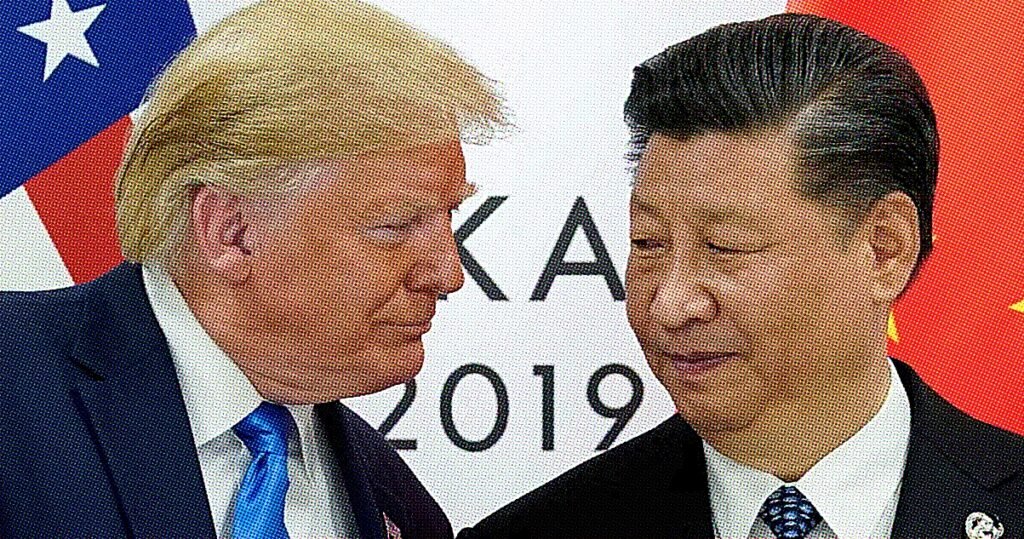
Donald Trump’s new message, contrary to that of several of his heads of agencies, seems to be “Bring on the spies for the Chinese Communist Party.”
Trump: “I hear so many stories about we’re not going to allow their students. We’re going to allow their students to come in. We’re going to allow. It’s very important, 600,000 students. It’s very important. But we’re going to get along with China.”
[Update: The White House later said that the president meant to refer to 600,000 or so students over two years, not to a prospective doubling of the number of Chinese students within one year. We may infer, then, that if he had said “It’s very important, 1,200,000 students,” he would have been referring to a four-year period. If he had said “It’s very important, 2,400,000 students,” he would have been referring to an eight-year period. And if he had said “It’s very important, 30,000,000 students,” he would have been referring to a hundred-year period, etc.]
The 600,000
If Trump’s comment is serious, maybe the idea is that the 600,000 students from the People’s Republic of China that he would welcome annually—up from more than 277,000 Chinese students studying here during the 2023-2024 academic year—can be properly vetted.
Among the factors that such an assumption omits from the reckoning is the possibility that a Chinese student of good will with no present intention of doing harm to the United States and no blot in his background may later be coerced by the CCP into acting against us. For example, by threats against family members back home.
The president’s observation that colleges and universities would struggle without their current proportions of Chinese students is an argument against accepting them, not an argument in favor of accepting them. Especially when we consider the extent to which so many institutions of higher learning here and abroad are beholden to direct funding from the Chinese Communist Party.
Over at Center for Immigration Studies, George Fishman provides a course in “Espionage 101: Don’t Enroll 600,000 Chinese Communist Party Spies at American Colleges: A key component of CCP plans to achieve military supremacy” (August 27, 2025).
But there are already too many students from the People’s Republic of China in the U.S.—277,398 in the 2023/24 academic year, totaling fully one-quarter of the entire foreign student population, with over half studying in engineering, computer science, and other STEM fields. What is most troubling about the specter of a record-breaking 600,000 PRC students inundating our college campuses is that their presence here is a key component of [the plan of] the Chinese Communist Party and People’s Liberation Army…to achieve military supremacy over the United States….
Larry Wortzel, visiting fellow at the Heritage Foundation, testified [two decades ago] before [the House Judiciary Committee’s Subcommittee on Immigration, Border Security and Claim that] “thousands of Chinese students and scientists were sent abroad by China over the years to pursue critical, civil and military dual-use technologies, and the practice still continues. Thus, the U.S. faces an organized program out of China that is designed to gather high technology information of military use.
“Chinese diplomatic missions abroad monitor the activities of their…students to cultivate informants, and before Chinese citizens get passports or travel permission, they are often interviewed by China’s intelligence security services and sensitized to intelligence collection requirements.”…
The threat has gotten far worse over the years, as the PRC has grown more sophisticated.
Fishman observes that what President Trump is saying today differs from what he was saying in 2020, when the White House of Trump’s first term issued a proclamation stating that “PRC authorities use some Chinese students, mostly post‑graduate students and post-doctorate researchers, to operate as non-traditional collectors of intellectual property [in part to bolster the modernization and capability of the PLA]. Thus, students or researchers from the PRC studying or researching beyond the undergraduate level who are or have been associated with the PLA are at high risk of being exploited or co-opted by the PRC authorities and provide particular cause for concern.”
Perhaps a debate can be arranged between Trump and Trump.
I don’t view any possible policy with equanimity. I know Chinese nationals who have immigrated to the U.S. and, over the course of many years, become a part of American society or who today wish (or did wish, prior to recent controversies) to come to the United States to study or live. They were or are motivated by a desire to escape the repressive society in which they grew up. But these are only a very few persons whom one can say I have personally vetted.
Even with the most careful screening, the nature of which the CCP would anticipate, how can U.S. personnel with the job of assessing applications for visas to study in the United States make the kind of judgments that take years to make? Whatever the risk of granting the visas may be, the greater the number of visas granted to PRC-born applicants, the greater the risk.
Also see:
StoptheCCP.org: “A Thousand Points of Chinese Espionage”
StoptheCCP.org: “Naturalized Citizen Jinchao Wei Convicted for Selling Secrets to CCP”
U.S. State Department: “The Chinese Communist Party on Campus: Opportunities & Risks”
AARR: “House Approves Legislation to Curb Chinese Communist Party Influence on U.S. Campuses” (May 8, 2025)