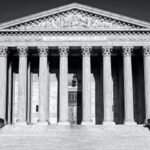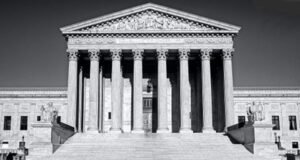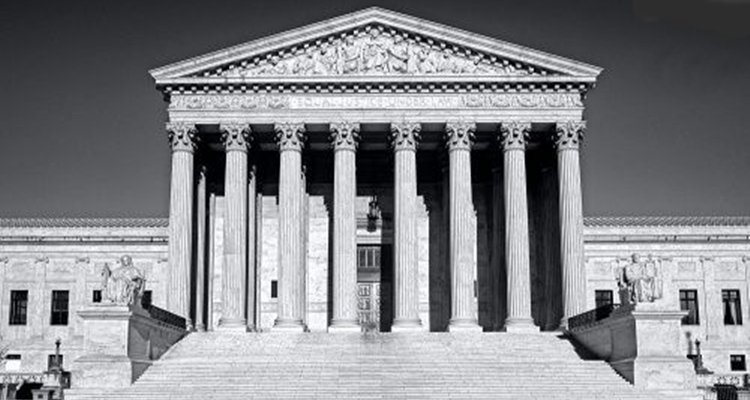
By 6 to 3, the U.S. Supreme Court has ruled that President Trump cannot use certain emergency powers to impose tariffs in an immediate and essentially unlimited way (Associated Press, February 20, 2026).
The Supreme Court struck down President Donald Trump’s far-reaching global tariffs on Friday, handing him a significant loss on an issue crucial to his economic agenda.
The 6-3 decision centers on tariffs imposed under an emergency powers law, including the sweeping “reciprocal” tariffs he levied on nearly every other country…
The majority found that the Constitution “very clearly” gives Congress the power to impose taxes, which include tariffs. “The Framers did not vest any part of the taxing power in the Executive Branch,” Chief Justice John Roberts wrote.
Justices Samuel Alito, Clarence Thomas and Brett Kavanaugh dissented.
“The tariffs at issue here may or may not be wise policy. But as a matter of text, history, and precedent, they are clearly lawful,” Kavanaugh wrote….
The Constitution gives Congress the power to levy tariffs. But the Trump administration argued that a 1977 law [the International Emergency Economic Powers Act or IEEPA] allowing the president to regulate importation during emergencies also allows him to set tariffs. Other presidents have used the law dozens of times, often to impose sanctions, but Trump was the first president to invoke it for import taxes.
Roberts wrote that “IEEPA authorizes the President to ‘investigate, block during the pendency of an investigation, regulate, direct and compel, nullify, prevent or prohibit…importation or exportation.’ ” That list, Roberts stressed, does not include tariffs or duties at all—an absence that “is notable in light of the significant but specific powers Congress did go to the trouble of naming. It stands to reason,” Roberts said, “that had Congress intended to convey the distinct and extraordinary power o impose tariffs, it would have done so expressly—as it consistently has in other tariff statutes.”…
Indeed, Roberts added, interpreting the word “regulate” in IEEPA to include the power to tax “would render IEEPA partly unconstitutional,” because it gives the president the power to regulate importation or exportation, but the Constitution specifically bars taxes on exports.
In a 63-page dissent, Justice Kavanaugh suggested that the majority’s decision “might not substantially constrain a President’s ability to order tariffs going forward, because numerous other federal statutes authorize the President to impose tariffs and might justify most (if not all) of the tariffs at issue in this case—albeit perhaps with a few additional procedural steps that IEEPA, as an emergency statute, does not require.”
China
NBC News reports that the high court’s ruling “does not affect all of Trump’s tariffs, leaving in place ones he imposed on steel and aluminum using different laws, for example. But it upends his tariffs in two categories. One is country-by-country or ‘reciprocal’ tariffs, which range from 34% for China to a 10% baseline for the rest of the world. The other is a 25% tariff Trump imposed on some goods from Canada, China and Mexico for what the administration said was their failure to curb the flow of fentanyl.”
According to a September 2025 report, the Trump administration has been investigating other ways to impose comparable tariffs in anticipation of a ruling against the president’s reliance on the International Emergency Economic Powers Act.
“The one that has received the most attention is Section 232 of the Trade Expansion Act of 1962, which empowers the president to adjust duties on specific goods ‘so that such imports will not so threaten to impair the national security’ after an administration investigation of trade practices. Many of Trump’s current and pending tariffs, on items like steel, aluminum and cars, fall under Section 232 and would not be directly affected by an adverse ruling on his use of IEEPA.”
I’m not sure how cheap steel or lumber from a friendly country impairs U.S. national security. But the president has many grounds for regarding various imports from the People’s Republic of China as impairing U.S. national security.
Also see:
X: U.S. Senator Rand Paul
“This ruling will also prevent a future President such as AOC from using emergency powers to enact socialism.”