We can add the 2024 U.S. law requiring that TikTok be sold to acceptable U.S. buyers or be banned in the United States to the stack of laws that should be but aren’t being followed (to be sure, probably shorter than the stack of laws that shouldn’t be but are being followed).
The TikTok deal as it’s been shaping up—to be concluded just a year or so later than the legislation’s firm and intractable deadline if the latest extension, of 120 days, is the last extension—looks pretty bad. Unless the reporting is much mistaken, the Chinese government will continue to be in a position to use the app to surveil Americans and spread CCP propaganda among them.
In which case, what was the point?
Hawks object
Under the deal as outlined, Americans will obtain nominal “majority control” of a U.S. version of the TikTok app. But the app is not to be sold to U.S. buyers outright as explicitly required by law. So “Trump’s TikTok deal still worries GOP China Hawks…” (New York Post, September 26, 2025).
Some of the problems with the deal were revealed to “key Republicans” during a closed-door briefing conducted by administration officials.
The new TikTok algorithm will be a version of the algorithm owned by Beijing-based ByteDance. The software company co-founded by anti-privacy mogul Larry Ellison, Oracle, which helped the CCP to develop its repression-facilitating surveillance technology, will have the job of rewriting the algorithm.
“Nevertheless, Congressional staffers remain skeptical whether the new algorithm can be rewritten to be completely protected from Chinese espionage given some of the wonky details of the deal disclosed during the briefing….”
According to one attendee of the briefing, the algorithm “will be leased by the Chinese to the U.S. TikTok for ten years, and Oracle won’t have a complete say in terms of how to change it.”
Doesn’t sound like a sale. Doesn’t sound like TikTok USA or the algorithm will be out from under the Chinese Communist Party at all.
Another non-sale-like aspect of the deal is that ByteDance will retain a 20 percent ownership stake. ByteDance will also be collecting a fee for licensing its algorithm, the algorithm that CCP collaborator Oracle won’t be able to freely rewrite. Combine these two major sources of revenue and it turns out that ByteDance will be collecting some 50 percent of the profits of TikTok USA.
None of this complies with the law nominally enacted in 2024 under which TikTok was to be banned in the United States unless sold—sold, S-O-L-D— to acceptable U.S. buyers.
Ties that bind
In the wake of a Trump executive order on the impending “sale” of TikTok, John Moolenaar, chairman of the House Select Committee on the Chinese Communist Party, has raised a stringent note of skepticism that seems doomed to be studiously ignored. He is reminding everybody that the law “set firm guardrails that prohibit cooperation between ByteDance and any prospective TikTok successor on the all-important recommendation algorithm, as well as preclude operational ties between the new entity and ByteDance.” Emphasis added.
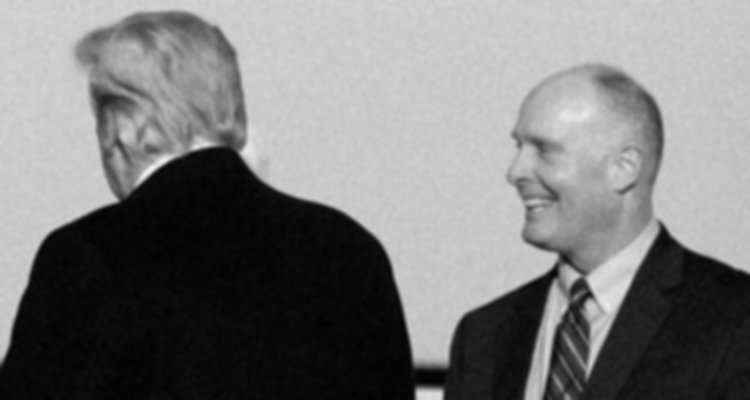
Perhaps Congressman Moolenaar (shown above, right) now regrets his generous interpretation back in January 2025 of President Trump’s first law-violating extension of the TikTok sale deadline.
Assuming that the deal putatively approaching completion is for real, one question that everybody—hawks, doves, pigeons—should be asking is why the Chinese Communist Party is going along with it.
Also see:
The White House: “Saving TikTok While Protecting National Security” (September 25, 2025)
“Under this Framework Agreement, TikTok’s United States application will be operated by a newly established joint venture based in the United States. It will be majority-owned and controlled by United States persons and will no longer be controlled by any foreign adversary, since ByteDance Ltd. and its affiliates will own less than 20 percent of the entity, with the remainder being held by certain investors (Investor Parties). This new joint venture will be run by a new board of directors and subject to rules that appropriately protect Americans’ data and our national security.
“Accordingly, I have determined that the proposed divestiture would allow the millions of Americans who enjoy TikTok every day to continue using it while also protecting national security.”