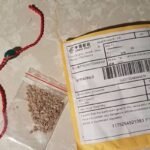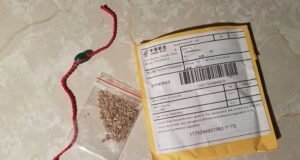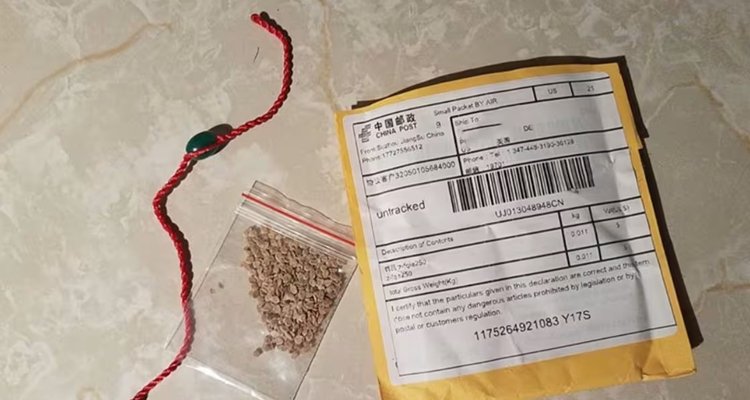
It started in 2020. “Mystery seeds from China are landing in Americans’ mailboxes.”
Now the seeds from China are back. State agriculture officials are worried. Stories are coming out of Ohio, West Virginia, New Mexico, Alabama. Packets are being delivered to bewildered recipients who never ordered them. “The Texas Department of Agriculture reported that last year [2025] it had collected, from 109 locations, 1,101 packs of seeds that had been sent unsolicited” to people in Texas.
Pests….
“At a glance, this might seem like a small problem, but this is serious business,” according to the head of that state’s agriculture department. “The possible introduction of an invasive species to the state via these seeds poses real risks to Texas families and the agriculture industry.”
The invasive-species line was repeated in state after state and falls back on tried-and-true messaging. This is a very old tune.
According to an Alabama entomologist, Meredith Shrader, “These seed packets may contain invasive insect eggs or larva that have been feeding upon the seeds during transport. We do not want to inadvertently introduce new potential pest species into the U.S. by opening these packets.”
But is that the threat from Chinese seeds, really? Or are officials and investigators just resorting to an older, canned litany?
Let us remember the news from June 2025, when two Chinese nationals, Yunqing Jian and Zunyong Liu, were “Charged with Conspiracy and Smuggling a Dangerous Biological Pathogen into the US for Their Work at a University of Michigan Laboratory.”
They had been caught “smuggling into America a fungus called Fusarium graminearum, which scientific literature classifies as a potential agroterrorism weapon. This noxious fungus causes ‘head blight,’ a disease of wheat, barley, maize, and rice, and is responsible for billions of dollars in economic losses worldwide each year. Fusarium graminearum’s toxins cause vomiting, liver damage, and reproductive defects in humans and livestock.”
…or agroterrorism…
Agroterrorism. That’s a few notches up the scale from the old standby threats of “invasive species” and “insect eggs.”
Professor Harold Kistler, University of Minnesota, disagrees that Fusarium graminearum is a means of agroterrorism. “It’s extremely prevalent in North America,” he says. “It likely arose in North America, so it’s not like a foreign agent coming in. And it’s already causing a lot of problems in US agriculture.”
Professor Kistler is generalizing. The question is actually about the exact strain of Fusarium graminearum that was brought in from Red China and the experiments that our two perps were planning to conduct.
The complaint against them said that Jian had “received Chinese government funding for her work on this pathogen in China. The complaint also alleges that Jian’s electronics contain information describing her membership in and loyalty to the Chinese Communist Party. It is further alleged that Jian’s boyfriend, Liu, works at a Chinese university where he conducts research on the same pathogen and that he first lied but then admitted to smuggling Fusarium graminearum into America—through the Detroit Metropolitan Airport—so that he could conduct research on it at the laboratory at the University of Michigan where his girlfriend, Jian, worked.”
Note the last sentence. He was going to conduct off-the-books research on a foreign-sourced noxious fungus. “Fusarium graminearum’s toxins cause vomiting, liver damage, and reproductive defects in humans and livestock.”
Would this be gain-of-function research?
They were caught; and around the same time, here comes a new wave of seed packets, right to your mailbox. Were some of those packets addressed to other secret researchers? Are the communists generating haystacks of mail to hide their poisoned needles?
…or brushing scam?
My AI tells me that “Unsolicited ‘mystery’ seeds appearing in mailboxes from China are part of a ‘brushing scam’ meant to boost fake, positive e-commerce reviews, not legitimate gardening products.”
The U.S. Postal Service explains how a brushing scam works. “A person receives packages or parcels containing various sorts of items which were not ordered or requested by the recipient… The sender of the item(s) is usually an international, third-party seller who has found the recipient’s address online.”
The sender is simulating the sale of a different product, for which he writes a favorable review in the name of the person who received the brushing-scam package.
Let’s find out
It’s not a stretch to suspect the CCP of being behind the seed packages. Two things need to happen. First, the people getting the seed packages need to search for their names among reviews on e-commerce sites like Amazon for reviews they did not write. If they don’t find their names, then what’s happening is not a brushing scam.
Second, instead of just telling recipients to report incidents and refrain from planting the seeds, state agriculture departments need to do the hard work of collecting these packages, testing the seeds, and publishing the results.
It’s playing with fire to let the seeds mystery linger. □
James Roth works for a major defense contractor in Virginia.