Red China has broken ground on a mega-dam project in Tibet, the Motuo Hydropower Station. It evokes familiar themes in the news stories. We hear, again, the common complaints that there will be damage to the environment, there will be effects downstream, there will be man-made disasters if and when systems fail.
This is not where the emphasis should be. Yes, dams retard rivers from silting; they can promote erosion, interfere with the movement of fish, change water levels, and reshape riverbanks and coastlines through changed flow. They change the lives of those who depend on a river. Where modernity breaks continuity, ruin seems to follow. But this dam project promises to itself become the man-made disaster.
The dam, really five dams, is expected to produce “300 billion kilowatt-hours of electricity annually, equal to the amount of electricity consumed by Britain last year.” Tibet does not need the amount of electricity consumed by Britain, and two neighboring Chinese Han provinces have a surplus of energy. “Nearby Sichuan and Yunnan have many hydropower plants, producing more energy than the region needs.”
State building
The Trivium China consultancy has put its finger on it. “Beyond energy security, policymakers likely also have state-building on the mind. The mega dam will anchor an unprecedented wave of industrial and infrastructure investment in Tibet—deepening Beijing’s control over the politically sensitive region.”
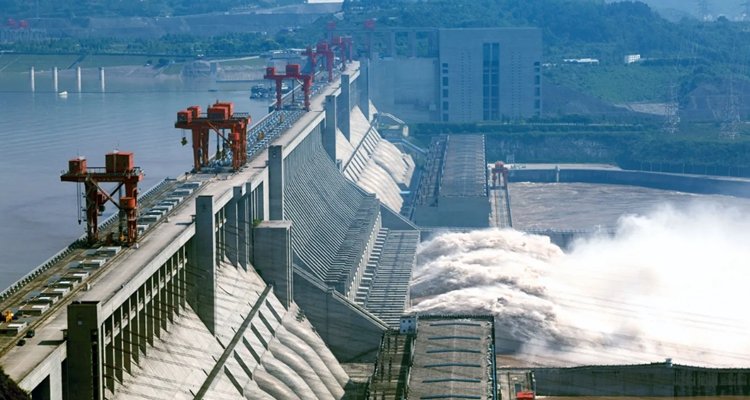
The Motuo project is much bigger than the Three Gorges Dam (shown above). That dam, “which took almost two decades to complete, generated nearly a million jobs, state media reported, though it displaced at least a similar number of people.”
What will happen to Tibet with a million Han immigrant construction workers? And that would be just the beginning. Recall that Soviet industrialization changed the demography of the Baltic states, Kazakhstan, and other places by attracting a significant Russian population to industrial sites and jobs.
Last year, Tibetans tried to warn us about the start of a different project, the Kamtok (Guangto) Dam. “Once built, the dam’s reservoir would submerge an area that is culturally and religiously significant to Tibetans, and home to several villages and ancient monasteries containing sacred relics. One of them, the 700-year-old Wangdui (Wontoe) Monastery, has particular historical value as its walls feature rare Buddhist murals. The Gangtuo dam would also displace thousands of Tibetans. The BBC has seen what appears to be a public tender document for the relocation of 4,287 residents to make way for the dam.”
The Save Tibet site notes that “the scope and scale of China’s single-minded push for ever more dams in Tibet has not been fully appreciated. The Chinese government has strategically obfuscated details of the hydropower expansion across Tibet, because the plans attract justified concern and scrutiny….
“From the 34 dams with public ‘relocation’ figures, at least 144,468 people are known to be affected by hydropower dams, with 121,651 people already expelled since 2000 and a further 22,817 to be expelled. If we extrapolate from available data to all 193 dams in our database, we estimate a lower limit of 750,000 people have been and will be expelled due to hydropower dams in Tibet.”
Water bomb
These figures are pre-Motuo. These figures are also pre-completion. Once the dams are in place and electric power is cheap and plentiful, the construction of an industrial infrastructure can begin. The import of millions of Han workers can begin. Tibet can truly become “Chinese.”
The New York Times calls the Motuo project “mysterious.” Beijing “has released few details about it. That includes the cost of the project, where the money will come from, what companies are involved and how many people are likely to be displaced. Even the dam’s basic design is unknown.”
The best chance of slowing this project down, and it is not a very good one, lies in the realm of geopolitics.
India’s Pema Khandu, chief minister of Arunachal Pradesh, “expressed concern that the Siang and Brahmaputra could ‘dry up considerably’ once the dam was completed. He added that the dam was ‘going to cause an existential threat to our tribes and our livelihoods. It is quite serious because China could even use this as a sort of ‘water bomb.’ ”
Unfortunately, concerns did not slow China’s damming of the Mekong River.
China’s activity on the Yarlung Tsangpo is part of a broader push to control Asia’s rivers. The most obvious example comes from the Mekong. Since the 1990s, China has built 11 large dams on the upper reaches of the Mekong (called the Lancang in China).
These structures have cut sediment flow by over half, leading to riverbank damage, falling fish numbers, and trouble for 60 million people depending on the river. Thailand, Vietnam, and Cambodia all report losses.
In Thailand, fishermen watch stocks drop and iconic species like the Mekong giant catfish vanish. The dams block fish migration and change water levels, worsening drought and hurting agriculture. Research published in 2023 showed how trapped sediment has wrecked local fishing industries.
In Vietnam, the Mekong Delta—a key rice-producing area—now suffers from saltwater intrusion and reduced yields. China’s refusal to coordinate with the Mekong River Commission means these countries often have little choice but to deal with the fallout.
Red China and Vietnam are members of the BRICS group, as is India, and yet these partners have “little choice but to deal with the fallout.” That’s how Beijing plays.
The Motuo Hydropower Station is going to “water bomb” Tibet, not India. And there doesn’t seem to be anything to be done about it. □
James Roth works for a major defense contractor in Virginia.