Huang Ching-lung hears a new note in one of the Chinese Communist Party’s familiar refrains. He detects a tacit admission that if the Party manages to gobble up Taiwan, the people there won’t really (unless very briefly) enjoy a “two-system” arrangement such as that which CCP officials uprooted as quickly as possible in Hong Kong (Taipei Times, November 11, 2025).
The Chinese Communist Party recently commemorated Taiwan’s “retrocession,” and for the first time said that the nation would be “governed by patriots” after unification [what the CCP, which has never governed Taiwan, typically calls “re-unification”]. The majority of Taiwanese do not understand the seriousness of what this phrase implies and reactions have been muted.
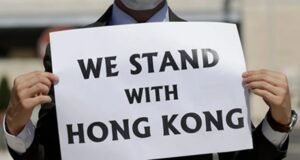
Look to Hong Kong’s experience as a cautionary precedent and see that a call for “governance by patriots” [implies] a meticulous and single-minded plan for institutional takeover….
There is no longer room for autonomy in Hong Kong’s governance; “patriots” have occupied every last inch.
Looking back, it is clear that Beijing’s political takeover of Hong Kong was a calculated and long-term project.
During the first phase in 2014 to 2019, united-front tactics and media infiltration led to the expansion of pro-China outlets, business interference and the suppression of civil society, which gradually eroded local autonomy. The pro-Beijing camp enjoyed executive control, but lost the support of the public, sparking the Umbrella movement and the 2019 anti-extradition protests.
Between 2020 and 2022, phase two saw the implementation of Hong Kong’s National Security Law, the dismantling of free elections and the establishment of the Office for Safeguarding National Security in Hong Kong. Political opponents were squashed, and electoral reforms introduced mechanisms to ensure that only “patriots” could run for positions of power—in effect, a mass silencing of the Legislative Council.
Huang also talks about a phase three, from 2023 to now. This seems to be just more of what was unleashed in 2020 by the first National Security Law.
The CCP’s subversive activities in Hong Kong did not so much commence as intensify during the “first phase.” The memoirs of Chris Patten, the last British governor of the colony, and other accounts make clear that the Party got started even before 1997, the year of the handover from Great Britain.
I’m also not sure that the recent statement about rule by “patriots” is the first time that CCP officials have revealingly used the word when talking about Taiwan’s post-unification status. The implication of what happened to Hong Kong is, at any rate, unambiguous; and if not all Taiwanese grasp the lesson, many do.
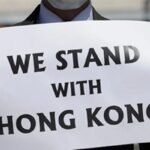
Huang’s broader point is of course valid. The best way for the Taiwanese to hold on to their democratic political system and their freedom is to never become part of the People’s Republic of China. Don’t buy a bill of goods. Remember Hong Kong.