A former major general of the Indian Army, R.P.S. Bhadauria, argues that as means of quelling dissent, “algorithms, phone data, and targeted detentions” have effectively replaced the tanks that rolled in to end the mass pro-democracy protests held in Tiananmen Square in the spring of 1989. The case study is the White Paper Revolution of a few years ago (Sunday Guardian [India], November 16, 2025).
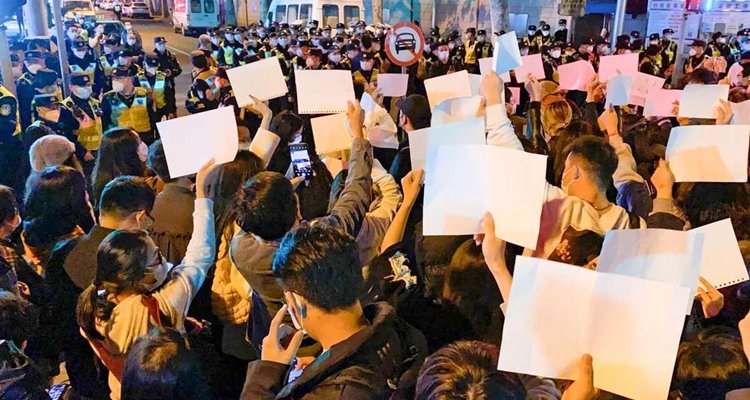
What began as a quiet vigil [in Shanghai] on 26 November [2022] evolved into the most overt public challenge to the Chinese leadership since the Tiananmen demonstrations more than three decades earlier. The crowds swelled, some chanting slogans that would have been unthinkable only weeks before. Yet the opening proved fleeting. By the morning of 28 November, the street was deserted. The sudden silence was not organic; it was engineered.
The speed with which authorities restored control demonstrated not only the strength of China’s policing apparatus but the degree to which three years of pandemic management had equipped the state with an unusually detailed map of its citizens’ movements, networks, and vulnerabilities….
The turning point came in the early hours of 27 November. As more demonstrators assembled some holding blank A4 sheets as understated rebuttals to censorship plainclothes officers blended into the crowd. Witnesses later described people being pulled into police vans at around 4:30am….
By mid-morning, uniformed officers sealed off the area….
The censorship campaign that followed was comprehensive and efficient. Searches for “Shanghai,” “Wulumuqi Road,” and “Urumqi fire,” which normally generated millions of posts, began returning only a handful. References to “white paper,” “A4,” and related hashtags vanished across Weibo and WeChat.
Outside China, Twitter (now X) became the only real-time window into what was unfolding. But even there, the state intervened. Researchers monitoring the platform reported hundreds of accounts suddenly posting spam pornography, gambling links, and unrelated advertising using the same protest-related hashtags. The effect was to bury genuine footage under noise, a tactic that prevented the protests from going viral internationally.
The Chinese Communist Party would rather surveil and censor protestors and arrest them quietly if in this way it can prevent or terminate large protests without having to mow everybody down in a massive assault.
But people can also become more alert to how the state is now tracking and identifying them. If their phones are what give them away when they attend a demonstration, they can attend without carrying a phone. Sophisticated cameras and facial recognition technology can be foiled, at least for a few hours, by an adequate disguise. Technology can be countered by other technology.
One can’t eliminate the risks of resisting a totalitarian state. Yet however formidable, no technologies and techniques of repression can enable officials to prevent protests or promptly end them if social discontent is widespread and intense enough, perhaps even spreading to elements of the government. Disagreement among top officials about how to respond to the mass protests was one of the problems that the Chinese Communist Party faced in 1989. (The 2008 book The Tiananmen Papers compiles leaked internal documents and other materials showing the course of the government’s discussions prior to the crackdown.)
That intra-Party dispute was resolved in favor of the tanks—mass murder. But neither military assault nor less immediately violent methods of repression like hyper-detailed maps of “movements, networks, and vulnerabilities” succeed inevitably.
Also see:
Associated Press: “US government allowed and even helped US firms sell tech used for surveillance in China, AP finds”