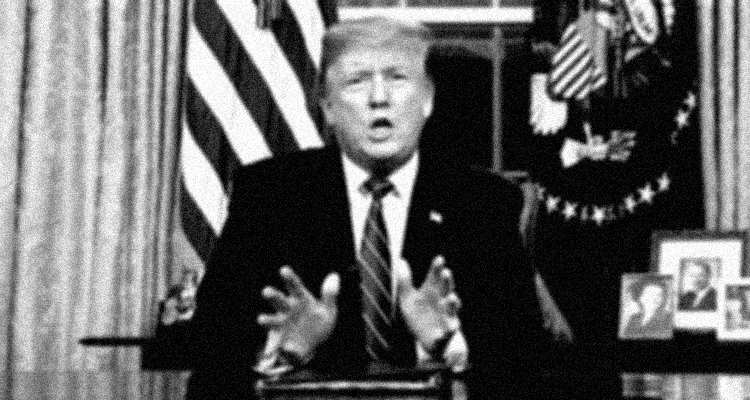
The President Trump who in his first term recognized that China is “a relentless adversary bent on exploiting, coercing, and cheating its way to global dominance at America’s expense” is now “retreating from his own record and emboldening China,” argue Marc Short and John Shelton (“Trump’s Retreat on China,” National Review, September 7, 2025).
The authors give several examples of retreat.
● Once sounding the alarm about the TikTop app, which (for one thing) “vacuums up Americans’ data and funnels it back to Beijing,” Trump is now an unconcerned fan and has even opened a presidential TikTok account. The U.S. has enacted legislation to force ByteDance to divest TikTok or be banned in the United States, but the president has repeatedly intervened to defer this reckoning.
● The president has also retreated in the use of export controls to prevent the Chinese Communist Party—and the People’s Liberation Army—from gaining easy access to the most cutting-edge American technology.
“Now, rather than preventing the sale of advanced microchips to China, he’s happy to sell that same tech as long as the U.S. government gets a cut. In the case of Nvidia, the feds will take 15 percent of revenue derived from the sale of H20 chips in China. Anyone who’s been paying attention over the past 20 years knows what will happen next: China will acquire Nvidia’s tech through coercion or outright theft, and eventually cut the company out altogether.”
● Trump’s tariff policies have “drifted into incoherence,” failing to deter China while driving “key regional partners such as India…closer to Beijing.”
● On the question of visas for Chinese students, the authors repeat, without noting the error, Trump’s misstatement that he would be open to “some 600,000 Chinese nationals enrolling in U.S. colleges,” a figure that a White House spokesman said was supposed to refer to the number of Chinese students coming here over two years. In other words, Trump was saying that the U.S. is open to accepting roughly the same number of Chinese students per year, some 270,000 annually, that currently attend U.S. institutions of higher learning. This is still a large number that the authors would say “invites the CCP to steal even more technology right here on American soil.”
Although these concerns are legitimate and serious, the arguments for each conclusion are too brief to be more than suggestive. The piece also neglects to mention any of the pluses in the Trump administration’s policies toward China.
State’s statement
The president is not alone in forming policy. Both the Congress (or at least one chamber of Congress) and various agencies continue to take significant steps to block and penalize the Chinese party-state.
In late May 2025, Secretary of State Marco Rubio announced that “the U.S. State Department will work with the Department of Homeland Security to aggressively revoke visas for Chinese students, including those with connections to the Chinese Communist Party or studying in critical fields. We will also revise visa criteria to enhance scrutiny of all future visa applications from the People’s Republic of China and Hong Kong.” This policy does not seem to have been rescinded in light of the president’s words welcoming Chinese students. (At least a few incoming students from the PRC have recently been turned back at the border.) But Rubio’s brief statement of policy has not been elaborated.
Of course, the more consistently the president supports the anti-CCP efforts of subordinates and colleagues, the better.
President Trump has time. A little. Three and a half years. One thing he should do is make a deal with himself to stop being concerned about whether he can make a deal with the Chinese Communist Party. Then maybe he will be less tempted to offer compromises of American security as bargaining chips.