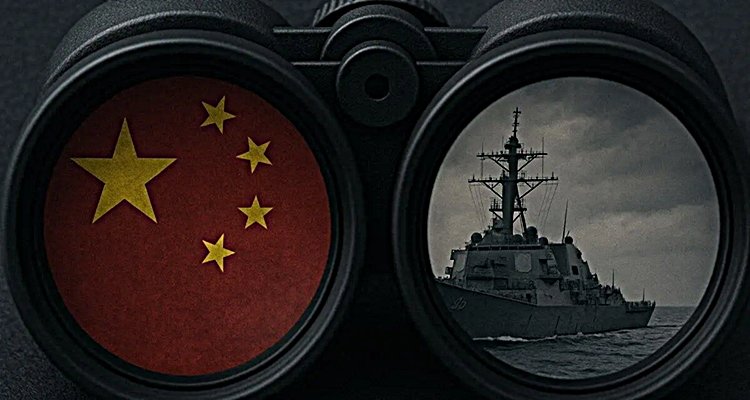
In February 2022, on social media, an intelligence agent for the People’s Republic of China contacted Jinchao Wei, a sailor in the U.S. Navy who had been born in mainland China (Maine Wire, August 22, 2025).
The intelligence agent had a cover story that Wei quickly penetrated…probably as soon as he was offered $500 in exchange for inside information about “about which ships were docked at the base on a daily basis.” The agent was also interested in naval maintenance systems.
“This is quite obviously fucking espionage,” Wei reportedly told his friend.
Wei’s friend told him that he should delete the contact. Instead, Wei transitioned his conversation with the Chinese spy to an encrypted messaging app and continued his espionage activities.
From March 2022 to the time of his arrest, Wei sent the intelligence officer photos of the Essex, reported on the locations of Navy ships, described defensive weapons, explained problems with ships, and sent thousands of pages of technical and operational information on naval ships stolen from a restricted computer. Overall, he also stole 60 technical manuals on naval systems, including a variety of sensitive information on naval ships.
Wei, a naturalized citizen, betrayed the U.S. for just $12,000 paid to him over 18 months….
He will be sentenced on December 1.
Maine Wire observes that Wei’s betrayal is hardly an isolated case.
Other Americans or Chinese nationals recently caught caught spying for the People’s Republic of China include former U.S. Army Seargent Joseph Schmidt, who on his own initiative sought, at first without success, to sell military secrets to the PRC; dual U.S.-Chinese citizen Chenguang Gong, who stole trade secrets from a military-contracting firm; Linwei Ding, who stole trade secrets from Google; and a group of five Chinese nationals who spied on the National Guard training facility Camp Grayling.