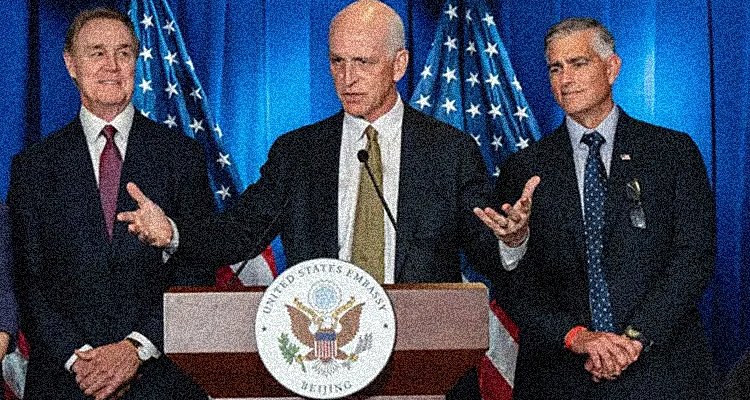
The best intelligence about what the People’s Republic of China can do militarily and what it’s going to do next may be hard and dangerous to obtain. But there is a good substitute, suggests U.S. Representative Adam Smith, leader of a bipartisan congressional group that went to China to meet with Premier Li Qiang as well as “China’s defense minister, its vice premier for economic policy, its foreign minister and the head of its rubber-stamp legislature” (New York Times, September 23, 2025).
This substitute is not to read the papers. “China is the most rapidly growing military, and the most rapidly growing nuclear power, in the world. The U.S. has the biggest military in the world and the biggest nuclear arsenal,” said Smith (shown above, center) at a news conference in China. “It is dangerous for us not to be having regular communications about our capabilities and intentions.”
What are the Chinese leaders’ responses to the U.S. leaders’ questions about its capabilities and intentions? The Times report doesn’t say. Increasing the frequency of such meetings, though, seems really to be more about gaining more opportunities for diplomatic persuasion and temperature-cooling than about gaining solid information about capabilities and intentions.
Anyway, do we need a lot more information about CCP intentions?
Planes, ships
Smith says that he raised the issue of “our ships, our planes, their ships, their planes, coming entirely too close to one another.” What was the response? Smith and the Times report nothing very specific.
The Chinese defense ministry did say that Dong Jun, China’s defense minister “had told the lawmakers that China was willing to build a ‘stable and positive’ relationship with the American military. But he also emphasized that the lawmakers should help improve communications, according to an official summary. And he said that China would defend its sovereignty and security.”
This means: 1) Yes, we’ll be your friends. 2) You are the cause of misunderstandings between us and diplomatic failures. 3) We’re not changing anything about our “intentions.”
What if the Chinese officials were instead to say: “We intend to continue causing trouble around the world, including in the Taiwan Strait and in the South China Sea, and we are very capable of doing so. Include new cyberattacks and harassments and kidnappings of Chinese nationals living overseas to the list. Plus all the other things we always do.” Would Smith et al. then surrender their delusions?
The Chinese government has been speaking by its actions. Diplomatic talks won’t change things. To the extent that such talks seem to be making progress, the Chinese reps are typically lying. What can have an effect is resistance.
Two-way street
In an early column for this site, James Roth pointed out that “the too-great cost of escalation can be a two-way street. China doesn’t always want to keep pushing come hell or high water either, as South Korea recently demonstrated when its coast guard ‘seized five Chinese vessels for allegedly fishing illegally in the country’s waters late last month, confiscating boats and deporting several crew members…. The country’s coast guard said that, on average, 300 Chinese vessels fish illegally in the country’s exclusive waters each day, with that figure dropping to an estimated 140 during periods of intensified crackdowns.’
“Periods of intensified crackdowns.… The risks of testing China’s will to escalate may not be as great as we think.”
The risks of inviting and going along with any amount of diplomatic baloney may not be as small as we think.
Also see:
StoptheCCP.org: “China, the Crazy Neighbor Who Just Won’t Leave People Alone”