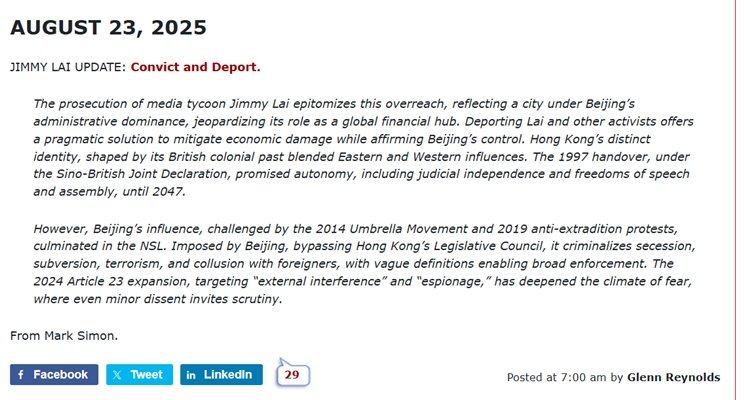
Substack author Mark Simon, who is seeking a “way out for an occupied city” (or what “now feels like an occupied city”), has advice that he hopes will help preserve Hong Kong as a financial powerhouse while “affirming Beijing’s control.” What cannot be extracted from the post, however, is any idea about why Beijing’s totalitarian control needs to be “affirmed” (“Convict and Deport: A Way Out for an Occupied City,” August 21, 2025).
“The prosecution of media tycoon Jimmy Lai epitomizes [Beijing’s] overreach, reflecting a city under Beijing’s administrative dominance, jeopardizing its role as a global financial hub,” Simon writes. “Deporting Lai and other activists offers a pragmatic solution to mitigate economic damage while affirming Beijing’s control.”
How to be a more popular totalitarian
The author concludes: “Deportation aligns with Hong Kong’s economic needs, mitigating damage to its global financial role by removing high-profile prisoners whose detentions draw scrutiny. Hong Kong’s transformation into an occupied city—marked by suppressed freedoms, a mainland-aligned identity, and a compromised judiciary—threatens its economic vitality. Deporting Lai and other activists could ease international pressure and restore some investor confidence, allowing Hong Kong to maintain its role as China’s financial gateway, with no loss of internal security.”
What does the Chinese Communist Party mean by “internal security”? What does it mean by “national security”? What does it mean by “collusion”? What does it mean by “subversion”? Any criticism of the CCP government and any attempt to expand, or introduce, freedom and democracy are the kinds of thing it means by these terms. If any such efforts stopped dead and the only thing that Hongkongers did from now on was obey and appease the Party and cooperate with its control of Hong Kong, we would indeed have “a pragmatic solution to mitigate economic damage while affirming Beijing’s control.”
The author then describes how the People’s Republic of China “promised autonomy” for Hong Kong for fifty years under the terms of the 1997 handover and then broke its promise. Yes. The PRC is a totalitarian dictatorship and in 1997 began immediately to undermine the rights and liberties of Hongkongers, a process culminating in the National Security Law imposed on Hong Kong in 2020.
And, “therefore,” we need to find a way to help the PRC to fine-tune its propaganda and public image and “ease international pressure”?
Just release the innocent victims
The control that the People’s Republic of China wants is global. That’s why we have so many accounts of the CCP’s transnational repression, kidnappings of Chinese nationals living overseas, etc., and why the Hong Kong (i.e., PRC) government has issued arrest warrants and rewards for information leading to the arrest of the most prominent pro-democracy activists who made good their escape and are now living in other countries.
With respect to Jimmy Lai and the many other innocent victims of Party tyranny now languishing in prisons, what the PRC government should do is only release them, and rescind all convictions (not “convict and deport”). Most or all former political prisoners in Hong Kong would then “self-deport,” escaping the Hong Kong government and mainland government.
But the CCP loudly and repeatedly and unambiguously objects to such self-deportation, which is why it has issued arrest warrants and bounties on the most prominent of Hong Kong’s many advocates of freedom and democracy now living overseas.
If Mark Simon is proposing that, to improve its public relations, communist China forthwith shut down all attempts at transnational repression, I’m all for it. But why stop there? Think how much better the public relations would be if the CCP gave up all efforts at domestic and international totalitarian control altogether, converted its dictatorship to a democracy, and implemented plans to dissolve and outlaw the Chinese Communist Party. The PR gains would be phenomenal.