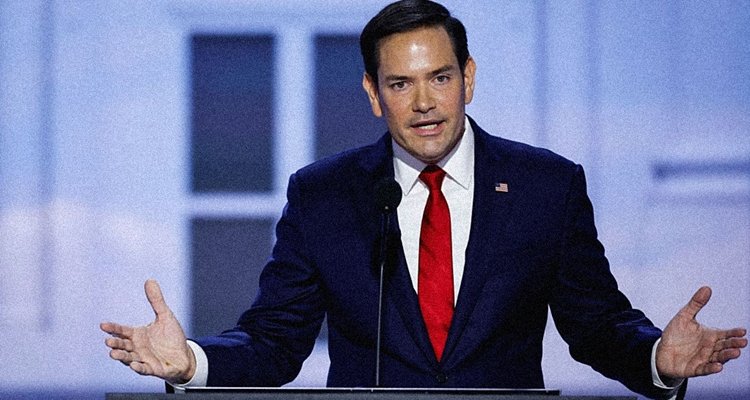
Has Secretary of State Marco Rubio “swapped hawk for diplomat in year-end pivot on China” in a recent press conference, as a South China Morning Post article argues (December 20, 2025)?
Let’s skip the SCMP article and the question of how recent the asserted pivot is and go straight to what Rubio had to say as preserved by a State.gov transcript. And here we find that his remarks do seem to be fuzzy and hedging. Part of the reason is that he “has a different job now.”
Question: You’ve been known for your tough rhetoric towards China over the years. Do you condemn…China’s recent provocative actions against Japan?
Answer: Yeah, no, I think I’ve been nice to China…in terms of the work we have to do with them and—I mean, I had another job. My job now is to—I represent the President of the United States and the United States in foreign diplomacy, and I think we’ve made good progress with the Chinese. The Japanese are a very close ally of the United States. I think these tensions are pre-existing. We understand that’s one of the dynamics that has to be balanced in that region. And I believe that we feel very strongly that we can continue with our strong, firm partnership and alliance with Japan and do so in a way that continues to allow us to find productive ways to work together with Chinese—the Chinese Communist Party and the Chinese Government.
Look, there’ll be tensions. There’s no doubt about it. I mean, at the end of the day, China is going to be—is and it will continue to be a rich and powerful country and a factor in geopolitics. We have to have relations with them. We have to deal with them. We have to find the things we are able to work together on. And I think both sides are mature enough to recognize that there will be points of tension now and for the foreseeable future….
But in the—and I think we can do that without imperiling or in any way undermining our very firm commitment to our partners in the Indo-Pacific that includes not just Japan but South Korea. And obviously if you extend further out—I don’t want to leave anybody out—but India and Australia and New Zealand and all the other countries. And we also have growing and burgeoning relationships with countries like Vietnam and even Cambodia that we really haven’t had very close contacts with historically. But we’ve talked to them a lot lately, obviously, through the context of the conflict going on with Thailand, but also to figure opportunities to work together strategically.
Rubio also fielded a question about China and Europe, but the above is enough to get the gist of the recalibration. We might boil it down to the following.
Summary
● Rubio will not, does not—not in this job—openly and unambiguously condemn the CCP’s vicious treatment of Japan and its prime minister. A reporter asked him explicitly whether he condemns that conduct, this was his chance, and his response was to hem and haw. In the privacy of his own mind, does Secretary of State Marco Rubio condemn the PRC’s conduct, the threat to decapitate the Japanese prime minister and all the rest of it? I’m sure he does; in his mind, it’s “yeah,” not “yeah, no.”
Perhaps Japanese ministers are right now sitting around a polished oak table lugubriously saying to each other, “You know, in the privacy of his own mind, Secretary of State Rubio probably does clearly and unequivocally condemn this treatment of us.”
● Rubio has been nice to China.
● Tensions between the PRC and Japan were pre-existing. Good point. The history of mankind did not start several weeks ago.
● China is a powerful country and is geopolitically important. Good point. It’s not a little town in the desert somewhere, that’s for sure.
● The U.S. can work with China, can work with Japan.
● We (the U.S. and China) “have to find things we are able to work together on.” I assume that this means something like the trade agreements rumored to have been reached by the Trump administration. This administration at least doesn’t seem to be pretending that it can or should “work with China” on furthering “climate change” folderol and various other nonsensical or destructive things.
● It is feasible to be nice to China without undermining commitments with “partners in the Indo-Pacific that includes not just Japan but South Korea,” as well as India, Australia, New Zealand, and “all the other countries.”
Commitments to what end? Alliances for what purpose?
I’m going to go out on a limb and say that the purpose of the partnerships is in large part to counter—by force (nice force?)—the vicious and nonstop, calculatingly ratcheted aggression of the Chinese Communist Party, as manifested in the Taiwan Strait, in the South China Sea near the Philippines, and elsewhere.
It seems that the U.S. must counter China, but never say, at least not too forthrightly, that we are countering China. We must oppose its conduct, but refrain from giving our allies the moral support entailed by explicitly and publicly condemning it as vicious. We must not explain to the world and our own children what is the nature of the Chinese Communist Party and its agenda and behavior.
It’s not that nobody anywhere is doing the job; many are doing the job, including within the U.S. government. But what the top leaders of the free or semi-free world are willing to say openly and unambiguously and consistently counts.
Also see:
The Diplomat: “China Intensifies ‘Three Warfares’ Targeting Japan Over Takaichi’s Taiwan Remarks” (December 5, 2025)
“Beijing is intensifying its use of public opinion warfare,psychological warfare, and legal warfare against Japan.”