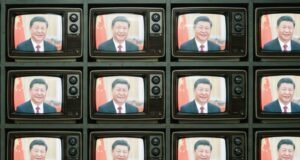
It’s done. The Chinese Communist Party’s Fourth Plenary Session of the 20thCentral Committee ended on October 23, 2025. The Party approved the general outlines of the next Five-Year Plan.
There was intense speculation about the concurrent purges and reported travails of Xi Jinping. The Mercator Institute for China Studies says that Xi remains in charge: “Xi can assume that he sits firmly in the saddle: The plenum celebrated the work of the 14th Five-Year Plan and achievements of Xi’s third term in office. The Plenum communique also suggests that the political purges in the name of anticorruption are far from over.”
Unactionables
The details of the Five-Year Plan will be worked out for release next year. But this is not your Soviet-style document with aims like “double the steel production” or “eradicate tuberculosis.” Nobody is facing a firing squad for performance shortfalls, because there is nothing here that anyone could be held to. Just some aspirational statements that in the business world would be called “not actionable.”
To take a few examples:
● Adhere to the central task of economic development.
● Expand high-standard opening up and forge new ground in win-win cooperation.
● Accelerate high-standard self-reliance and strength in science and technology to lead the development of new quality productive forces.
These translations may be faulty, but you can see that the authors have left plenty of wiggle room for future implementation.
Commissar, tell me, how do I measure all of the new ground I forged in win-win cooperation?
What about past objectives? Was anything accomplished? Is there a next phase to build on? The emphasis here is new, new, and more new. The text of this prospective Five-Year Plan does not mention the past. There don’t seem to be any corrective items, any unfinished business, any mistakes to address. The past is dead.
An end-of-Plenum press conference emphasized Xi Jinping’s hands-on work at this stage, shaping the final document. So approval was baked into the cake. “General Secretary Xi Jinping personally served as the head of the drafting group, personally planned, provided guidance throughout the process, and set the direction, playing a decisive role.”
Since the last Five-Year Plan reflects on Xi and Xi is the principal author, no surprise that it is future-looking given the state of Red China’s economy.
Unmentionables
Several analysts have noted that the new plan does not refer to finance and does not refer to real estate, two problem areas.
If the Reds “accelerate high-standard self-reliance and strength in science and technology to lead the development of new quality productive forces,” do they think that these are the engines to pull them out of the current (apparently unmentionable) economic mess?
Bonnie Glaser of the German Marshall Fund wonders how to interpret the lack of specificity. “Do you think that the 15th Five-Year Plan will lay out very concrete actions or…are we just seeing some language that won’t be followed up by concrete policies?” Her guest, Brookings Fellow Jonathan Czin, says “I’m more in the latter camp” and “there’s very meager follow- through.”
The Indian news portal Firstpost also observes an absence of clarity here:
The past Fourth Plenums historically had decisive themes and outcomes. During Mao’s era in 1958, it was ideological consolidation; in 1979, during Deng’s time, it was political stability; in 1999, Jiang Zemin focused on legal institutional reforms; in 2004, during Hu Jintao’s presidency, it was governance capacity and harmony; and in 2014, Xi Jinping prioritised centralised control and party supremacy.
Consider also this summary from British think tank Chatham House:
Foreign observers should not expect Beijing to revive its sluggish property market or grant more financial autonomy to local governments. The direction is clear: expect deeper central government intervention, with capital and policy support channeled into strategic and high-tech sectors. Beijing will continue to coordinate from the center in its ‘whole of nation’ approach.
An Indian analyst offers the most pithy summary of the five-year wish list: “industry first, innovation second, and security everywhere.”
After the plenum, the Guardian reported that “officials pledged to continue their crackdown on ‘involution’—a reference to fierce internal competition that has produced damaging price wars and oversupply. China must become a unified national market, officials said, pledging to boost regional economies and address local government debt, stagnating wages and deflationary pressures.”
Yin and yang
Think of it, on the one hand, as industry being first and innovation second; and, on the other hand, as competition being bad for the economy, bad for innovation, bad for growth. Got it?
We’re going to need another plenum to sort this out… □
James Roth works for a major defense contractor in Virginia.