The new prime minister of Japan, amateur heavy metal drummer Sanae Takaichi, has “embraced hawkish policies on China,” says The New York Times, resorting to a frequent characterization of any tendency to prefer non-suicidal policies on China (October 21, 2025).
Takaichi was a protégé of Shinzo Abe, the longtime prime minister who was assassinated in 2022 after he was no longer in office. The Times described him as casting Japan “as the regional leader upholding free trade and the rule of law against an increasingly aggressive China.”
Extremely important partner
Soon after winning the leadership of the Liberal Democrat Party and not long before being elected prime minister, Sanae Takaichi reiterated her support for the Republic of China. On Twitter-X, she said, as Google-Translated, that “Taiwan is an extremely important partner [of Japan] and a valued friend, sharing fundamental values and enjoying close economic ties and people-to-people exchanges. I look forward to deepening cooperation and exchanges between Japan and Taiwan” (October 12, 2025).
This isn’t very obedient to the People’s Republic of China, which has ordered the world to avoid interacting with Taiwan out of respect for the PRC government’s various psychoses.
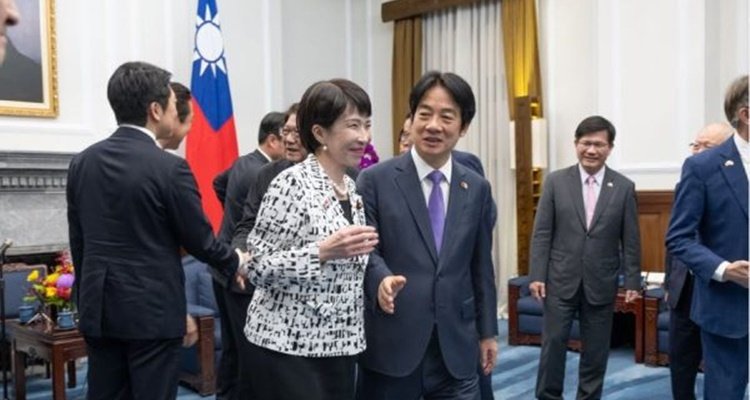
In April 2025, Takaichi, at that point known for having almost won the right to lead her party in a 2024 contest, met with ROC President Lai Ching-te (shown with her above) and “called on Japan, Taiwan, and other regional democratic partners…to form a ‘quasi-security alliance’ given the unpredictability of the United States” (Focus Taiwan, April 28, 2025).
[Sanae Takaichi] said many Japanese had a false belief that the U.S. would unconditionally defend Japan based on the 1960 U.S.-Japan Security Treaty….
In fact, Taiwan and Japan are facing similar situations, and both need to strengthen their respective self-defense capabilities, she said.
One cannot rely on a single country alone for protection in the current global environment…and while each country is engaging in strengthening their own defense capabilities, like-minded allies should also join forces to face challenges, she said.
Writing in The Diplomat, Rupakjyoti Borah agreed that “Taiwan’s security is critical for Japan’s own security. If Taiwan falls under Beijing’s control (and China has been quite aggressive toward Taiwan in recent years), it will be a real worry for Japan. Yet none of the countries Takaichi mentioned has formal diplomatic relations with Taiwan, which adds a major complication to defense cooperation.”
On the other hand, “the kernel of Takaichi’s ‘quasi-alliance’ idea already exists”: the Quad, which includes Australia and India as well as Japan and the United States. But “there are deep uncertainties about the limits of security cooperation between them.”