This question or a close analog comes up too often. It’s probably best to give the benefit of the doubt and assume that Pope Leo, like his predecessor, is merely a coward, not actually eager in his enabling of the Chinese Communist Party’s repression of the members of his own church to which he tacitly assents by “working with” the Party.
The story last year was that “Facing China, Leo XIV follows in the footsteps of Pope Francis by appointing a bishop in Fuzhou” (Le Monde, June 14, 2025).
On Wednesday, June 11, the Vatican announced that six days earlier, on June 5, it had appointed an auxiliary bishop in this city of nine million people. At the same time, the official Church, overseen by the Chinese Communist Party, held a ceremony on that Wednesday to formally acknowledge the appointment. These two gestures of mutual goodwill occurred in a context that is often tense. China remains the only country where bishops are jointly appointed by local authorities and the Vatican, under a 2018 agreement intended to ease tensions between the two states and to end the system of two parallel Churches—one “official,” the other “underground.” Elsewhere in the world, this is an exclusive prerogative of the Holy See….
By appointing the auxiliary bishop of Fuzhou, [Pope Leo] has signaled his support for the agreement signed by his predecessor, the details of which have never been made public. In return, he has received a gesture of goodwill from Beijing.
“China is ready to work with the Vatican to promote the continued improvement of relations between China and the Holy See,” said Lin Jian, spokesperson for the Chinese Ministry of Foreign Affairs, on Thursday. This message from China has been viewed more positively because the appointed cleric, Joseph Lin Yuntuan, age 73, was consecrated in 2017 by Rome within the so-called underground Church, which rejects State-Party control over religious life. By integrating him into the official Church at the same time as his appointment in Fuzhou, China has taken a step forward.
What is the official Church? The CCP-controlled church.
The Vatican put the best face on its willingness to continue accepting the CCP’s control of Catholic affairs by acknowledging the fact that, in the words of theologian Michael Chambon, Beijing “has officially acknowledged an underground bishop,” which means that “both sides are openly expressing their willingness to build a working relationship.”
Meanwhile, the Party has continued its assaults on members of “underground” churches—non-CCP-affiliated Catholics and other Christians, and persons of other faiths.
A month after the celebrated rapprochement occasioned by the bilateral appointment of Joseph Lin Yuntuan, CatholicVote Civic Action reported on the case of Father Ma Xianshi, a Catholic priest detained “for allegedly distributing a sacred hymn book without state approval.”
Last September, the U.S. Commission on International Religious Freedom reported that religious leaders in China “must conform to the Chinese Communist Party’s political ideology and submit to the state’s intrusive system of control in order to legally engage in religious activities. Those who refuse face severe punishments, including surveillance, fines, retribution against family members, detention, political reeducation, forced labor, imprisonment, enforced disappearance, torture, and other forms of mistreatment and abuse.”
The Vatican’s “working relationship” with the Party hasn’t changed any of this.
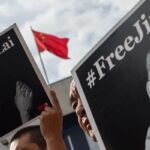
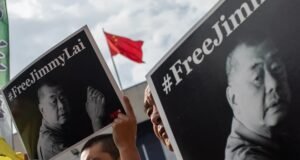
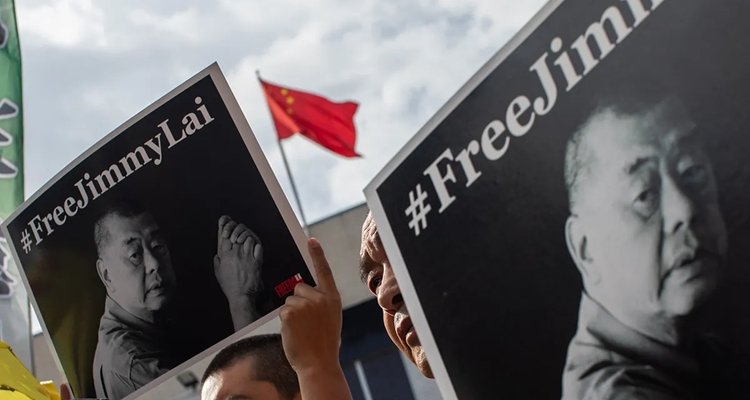
Now, when asked his opinion of the twenty-year sentence that the CCP imposed on Jimmy Lai, former publisher of the pro-democracy Hong Kong paper Apple Daily, Pope Leo says: “I can’t comment. Let’s pray for less hatred and more peace and work for authentic dialogue.”
The fruits of cooperation.
Also see:
USCIRF: “Factsheet: China’s Persecution of Religious Leaders”