Tibetans living in exile in India seem to have a better idea of Xi Jinping than the Indian government, which detained Tibetan protesters to ensure that Xi’s visit on September 12 and 13 would go smoothly. Xi was attending the BRICS Summit being held in New Delhi (The Hindu, September 13, 2026).
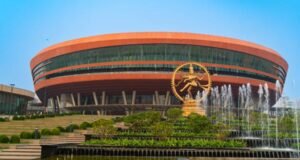
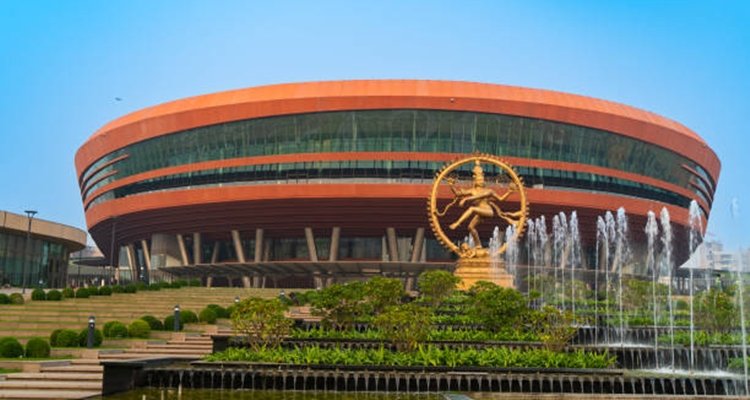
As many as 64 members of the Tibetan Youth Congress were detained by Delhi Police on Saturday night after they stormed the Bhairon Marg near Bharat Mandapam [a convention center, shown above] protesting against Xi Jinping’s visit to India.
The protesters carried the Tibetan national flag and ran towards the venue when they were stopped by Delhi Police officials and detained. The visuals showed some of them being dragged by the police.
The protest was held under the banner of the Tibetan Youth Congress, which said that it condemned Xi Jinping’s visit to India due to major human rights violations by the Chinese Communist Party, systemic violence and suppression of Tibetan language, religion and culture….
“China has been continuously violating human rights of Tibetans and suppressing Tibetan culture and religion. We demand that Tibetan political prisoners in China be released, mindless construction on the Tibetan plateau be stopped, and there be no interference of China in Tibet’s religious matters,” said Tenzin Lobsang, General Secretary, Tibetan Youth Congress.
“The question of Tibet remains directly connected to India’s national security and regional stability,” he added.
On September 11, protesters who climbed poles near an underpass to wave anti-Xi flags had also been detained. The various protesters are expected to be released on September 14.
Indian Prime Minister Narendra Modi and the Chinese dictator, Xi Jinping, met on the sidelines of the BRICS meeting to discuss India-China relations as part of what reports call a “cautious thaw” between the two countries. In 2020, twenty Indian soldiers and four Chinese soldiers had been killed in a border clash, exacerbating tensions. China and India have been disagreeing about their borders since the 1950s, the years during which the new People’s Republic of China conquered and occupied Tibet.
Three mutuals, five principles
The topics that Xi and Modi discussed included border issues, cultural exchanges, trade relations, and what Modi called the “three mutuals” that should guide the relationship between the two sides (“mutual respect, mutual sensitivity, and mutual interest”). Nothing about Tibet, which India had once regarded as a buffer between itself and China.
The three mutuals seem to be a condensed version of the Five Principles (Panch Shila) which “were, ironically, articulated in a treaty with China over the Tibet region in 1954, when Nehru still hoped for Sino-Indian ‘brotherhood,’ ” Britannica recounts.
These principles were “mutual respect for other nations’ territorial integrity and sovereignty; nonaggression; noninterference in internal affairs; equality and mutual benefit; and peaceful coexistence.”
Also see:
PolSci.Institute: “The Tibet Issue in India-China Relations: Historical and Strategic Perspectives” (October 10, 2025)
The significant cost of the Panchsheel agreement of April 29, 1954 “became clear only later. By signing a treaty that explicitly referred to the ‘Tibet Region of China,’ India formally acknowledged Chinese sovereignty over Tibet. The old idea of Tibet as a separate buffer was set aside in the language of the very first major treaty between the two republics. India had effectively traded its leverage over Tibet’s status for the promise of friendly relations….
“For India, the Dalai Lama’s presence [after he was granted asylum by the Indian government] became a symbol of solidarity with the Tibetan people. But it also hardened Chinese suspicion at exactly the moment when the unresolved border was becoming dangerous. The goodwill of the Panchsheel years evaporated quickly.”