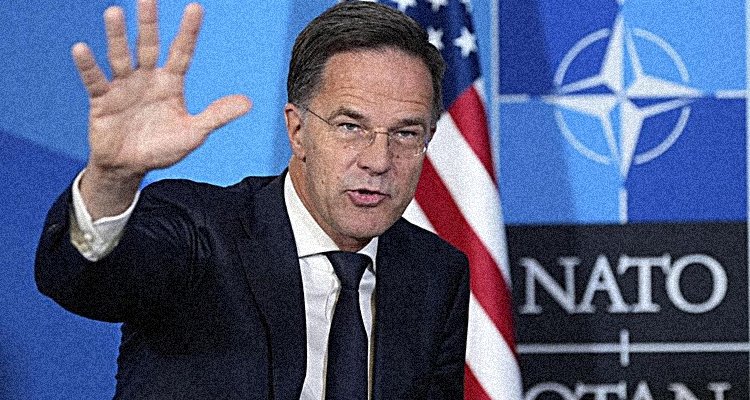
NATO Secretary General Mark Rutte thinks that if the People’s Republic of China attacks the Republic of China, Russia may agree to attack Europe, the better to distract NATO countries from other global happenings.
In a July 5 interview with The New York Times, the former prime minister of the Netherlands (shown above) says that “for the first time in 65 years, we will equalize between what the U.S. is paying and what the Europeans are paying. And without Trump, that would not have happened.”
Indo-Pacific and Atlantic
That the European NATO countries beef up their defenses is crucial because Russia “is reconstituting itself at a pace and a speed which is unparalleled in recent history,” Rutte says.
Russia is “now producing three times as much ammunition in three months as the whole of NATO is doing in a year. This is unsustainable, but the Russians are working together with the North Koreans, with the Chinese and Iranians, the mullahs, in fighting this unprovoked war of aggression against Ukraine. So here, the Indo-Pacific and your Atlantic are getting more and more interconnected. We know that China has its eye on Taiwan. Given this whole geopolitical setup, there is no way we can defend ourselves if we stick to this old 2 percent [of gross domestic product].”
If the NATO allies don’t boost defense spending and capability enormously, “we’ll have to learn Russian.”
Although China pretends (sometimes) to be above the fray of the Ukraine war, China is in fact helping Russia to fight it. Would Russia in turn help China to fight a full-scale war with Taiwan?
Rutte thinks that if Xi Jinping decides to start that war, he would first call “his very junior partner in all of this, Vladimir Vladimirovich Putin” and tell Putin that as China attacks Taiwan, “ ‘I need you to keep them busy in Europe by attacking NATO territory.’ ”
NATO must do two things to deter China and Russia. One is be so strong that Russia won’t be tempted to attack regardless of any favors it owes China. The other is “working together with the Indo-Pacific”: the ROC, the Philippines, Japan, Australia, etc.
NATO’s current plan, Rutte says, is that the Europeans will gradually “take more of the burden for the defense of this part of NATO territory…so that the U.S. can therefore pivot more toward Asia, toward the Indo-Pacific, as the U.S. should. This is also in our European interest, because we know that China and North Korea are very much involved in this war effort in Ukraine. So this is all interconnected.”
A strong democracy
Rutte more than once objects to various of the interviewer’s assumptions about Trump, the United States, and NATO. One such is the notion. One is a notion tucked into a question on NATO and democratic values as if it were a point so obvious that it needn’t be raised separately: that the U.S. is “democratically backsliding.”
We don’t know exactly what the Times reporter means by this. Some Americans suppose that it’s undemocratic to check whether a prospective voter is a citizen before he can vote or register to vote. Or that it’s undemocratic for the chief executive of the federal government to exert executive control over the executive branch.
Be that as it may, Rutte makes clear that “I would not agree with this. I think the U.S. is still one of the strongest democracies on Earth.”
Also see:
Atlantic Council: NATO defense spending tracker
CNN: “China tells EU it can’t accept Russia losing its war against Ukraine, official says”