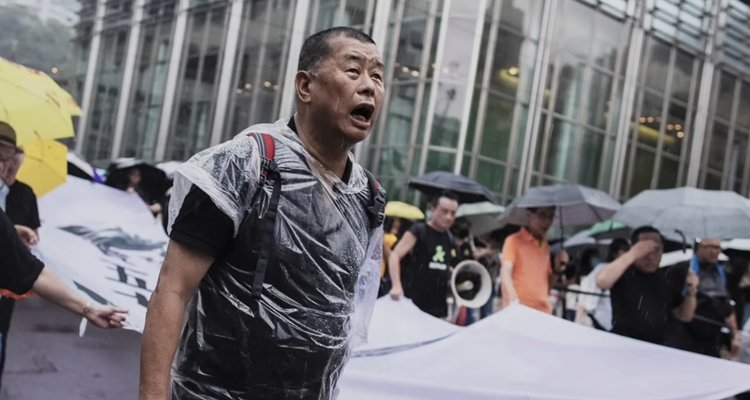
The first day of a hearing on whether to grant former Hong Kong publisher and innocent victim Jimmy Lai any leniency in his sentencing presented no surprises.
The long-drawn-out show trial of Lai lasted on and off from December 18, 2023 to August 28, 2025. The court then took several weeks to ponder the verdict. Memorializing its rationalizations in 855 pages, the judges ultimately concluded that Jimmy Lai, former publisher of the pro-democracy Hong Kong paper Apple Daily, had indeed been a major leader of the resistance to the tyranny of the Chinese Communist Party. Guilty as charged.
The question now is whether Lai’s punishment will be ameliorated in light of his age or other considerations (Nikkei Asia, December 12, 2026).
The mitigation plea for Lai took place in the afternoon, with his defense lawyer focusing on his health. Lai, who turned 78 last December, has spent more than five years in solitary confinement and suffers from conditions including hypertension, diabetes and cataracts.
The prosecution, which presented its arguments ahead of the defense, described Lai’s health as “unremarkable,” citing a report by the Correctional Services Department.
Under Hong Kong judicial process, convicted defendants may submit mitigation pleas in an effort to reduce their sentences. Lai faces a possible life sentence, the heaviest punishment in a city that abolished the death penalty decades ago….
The Hong Kong government has repeatedly hit back against criticisms of the verdict. In a statement issued on Jan. 2 in a rebuttal to BBC reporting on the case, a government spokesperson said the court’s ruling was “well-founded and reasoned,” and “strictly in accordance with the law and evidence, free from any interference, and absolutely free of any political considerations.”
One observer has noted that even if Lai is spared a life sentence, a ten-year sentence would amount to the same thing given his advanced years.
CCP propaganda outlet China Daily asserts that Lai’s conviction proves the effectiveness of the Hong Kong legal system “for safeguarding national security,” “national security” being the Party’s top hyped-up synonym for its tyrannical control.
The validating expert cited by China Daily is an accomplished lawyer currently serving in Hong Kong’s Legislative Council named Nick Chan Hiu-fung. For the last several years, the Chinese Communist Party has permitted only reliably submissive “patriots” to sit in Hong Kong’s Legislative Council.
An online biography of Chan states that he was “excited by the establishment of the Hong Kong Special Administrative Region in 1997,” the year that Great Britain turned Hong Kong over to the People’s Republic of China and set the stage for the persecution of Lai and other pro-freedom activists. It adds that Chan “participated in…the formulation of various influential laws and policies,” including the PRC’s fourteenth Five-Year Plan and the National Security Law imposed on Hong Kong that erased what remained of the political rights and independence of Hongkongers. And that he has a “strong commitment to promoting peace and the rule of law.”
Limits
According to China Daily, this legal mind “stressed that freedom of the press is protected under the HKSAR Basic Law, but freedom has never been without limits.”
You could say that the fact that a person’s rights and freedom do not entitle him to violate the rights of others constitutes a “limit” on his freedom. But this restriction is not a limit to any freedom which one has by right. No one, in or out of the government, has the “right” to act as a criminal. The relevant boundary-demarcating principles are not respected consistently by any government. But they are not respected at all by the governments that are the most tyrannical. In the case of the People’s Republic of China, the limits on freedom are limitless.
Also see:
Acton Institute: “The Hong Konger: Jimmy Lai’s Extraordinary Struggle for Freedom [Full Film]”