As evidenced by its decision in 2024 to explicitly include the death penalty as one possible cost of being a “Taiwan independence diehard,” the Chinese Communist Party may be losing confidence in the possibility of “peacefully” uniting with Taiwan and the other islands of the Republic of China, argues Guermantes Lailari (“Keeping Taiwan Safe: Best Possible Options,” Taipei Times, March 3, 2025.
According to recent polling, few Taiwanese, about 13 percent, a percentage that has been decreasing, want their country to be taken over by the mainland; 76 percent, a percentage that has been increasing, “prefer the status quo” or “moving towards independence.” I’m not sure what the difference is between “status quo” and “independence,” since the status quo is independence. Perhaps, in addition to the linguistic-diplomatic dishonesty enshrined by the practices of decades, “independence” also means “no more harassment by the mainland.”
Some Taiwanese are in denial about the danger of war, says Lailari, “a retired U.S. Air Force officer specializing in counterterrorism, irregular warfare, missile defense, and strategy” who also lists affiliations with Taiwanese universities and other institutions.
Nevertheless, “war is coming.” Unless it can be prevented. What to do? Lailari offers what he calls “forbidden” suggestions.
Increase military spending
The Taiwanese public should demand that the Legislative Yuan get its act together and strengthen national defense. Recent efforts to recall Kuomintang or Taiwan People’s Party legislators who oppose this goal will, if successful, enable Democratic Progressive Party legislators to obtain the majority they need to increase defense spending.
“Since last year, the Chinese Nationalist Party [Kuomintang] and the Taiwan People’s Party have eroded Taiwan’s defense through a series of legislative maneuvers: freezing budgets, reallocating defense funds to other purposes, cancelling investments or cutting new weapon systems budgets…. Taiwan must increase its defense capabilities to deter the CCP.” Lailari says that the ROC’s annual defense spending should be about $40 billion USD, which would be 5 percent of GDP.
Adopt a new tariff agenda
If Trump follows through on his seemingly perverse idea of imposing steep tariffs on Taiwanese semiconductors, the U.S. could “use the income from these Taiwanese tariffs to pay for weapons that Taiwan cannot produce themselves…. The defense budget for purchasing foreign weapons would shift from the Legislative Yuan to the US government. This means that money planned for Taiwan’s external weapons budget could shift to spending on extended training and more military personnel, especially reservists.”
More training is important because “only 7 percent of Taiwan’s 1.66 million reservists receive any training after they complete their mandatory service…. If a smaller country like Israel can call up almost four times the reservists for 42 days of training every year, Taiwan should be able to train at least 1 million reservists annually for more than two weeks.”
Lailari would also impose conscription more widely and require two years rather than one year of military service.
Update U.S. legislation
The U.S. Congress should revise the Authorization for Use of Military Force, passed in 2001, in order to give President Trump greater latitude in dealing with CCP aggression.
Sign new defense treaties
The ROC and the United States should establish a mutual defense treaty that “could be a bilateral MDT and/or a multilateral MDT to incorporate South Korea, Japan, Taiwan, the Philippines, and others…. A nascent version…already exists with the US-Japan-ROK [South Korea] Trilateral Security Pact.”
Add Taiwan to the United States
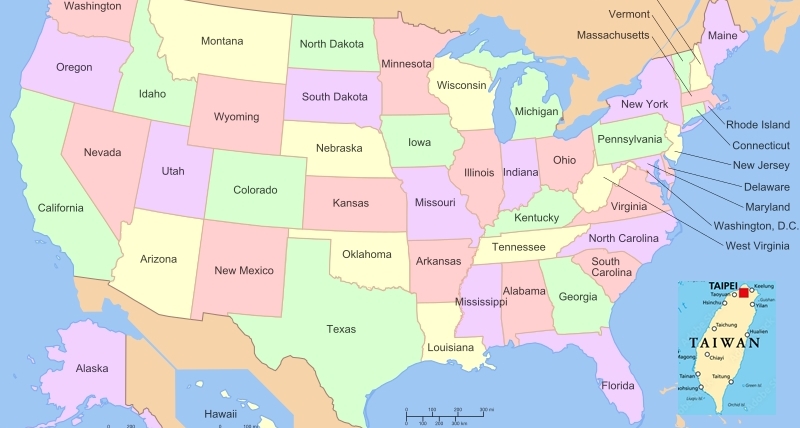
Taiwan (and presumably the other islands of the ROC) could become a U.S. territory or a U.S. state. Would China be willing to invade Taiwan if it could do so only by simultaneously invading the United States?