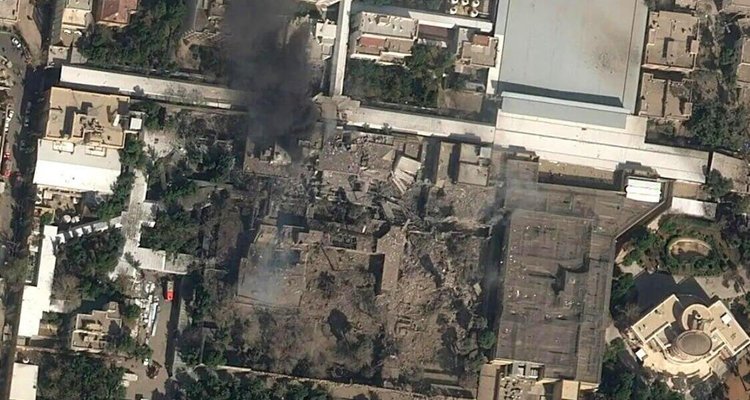
Israel’s detailed surveilling of Tehran in the hours, days and years preceding the U.S.-Israeli attack on Iran reminds Americans that other countries—for example, the People’s Republic of China—are also pretty good at surveillance.
CTech reports (March 2, 2026):
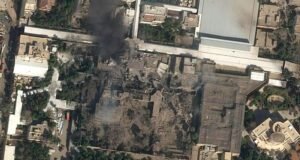
Years before the air strike that killed Ayatollah Ali Khamenei, Israeli intelligence had been quietly mapping the daily rhythms of Tehran.
According to reporting by the Financial Times, nearly all of the Iranian capital’s traffic cameras had been hacked years earlier, their footage encrypted and transmitted to Israeli servers. One camera angle near Pasteur Street, close to Khamenei’s compound, allowed analysts to observe the routines of bodyguards and drivers: where they parked, when they arrived and whom they escorted.
The capabilities were part of a years-long intelligence campaign that helped pave the way for the ayatollah’s assassination. This source of real-time data—one of hundreds of different streams of intelligence—was not the only way Israel and the CIA were able to determine exactly what time 86-year-old Khamenei would be in his offices this fateful Saturday morning and who would be joining him.
Nor was the fact that Israel was also able to disrupt single components of roughly a dozen or so mobile phone towers near Pasteur Street, making the phones seem as if they were busy when called and stopping Khamenei’s protection detail from receiving possible warnings.
Long before the bombs fell, “we knew Tehran like we know Jerusalem”, said one current Israeli intelligence official. “And when you know [a place] as well as you know the street you grew up on, you notice a single thing that’s out of place.”
The dense, intelligence picture of the arch-enemy’s capital was the result of laborious data collection, made possible by Israel’s sophisticated signals intelligence Unit 8200, the human assets recruited by its foreign intelligence agency Mossad and the mountains of data digested by military intelligence into daily briefs.
“One might wonder about how long the Chinese have been doing the same to DC, our major cities, military bases and military contractors,” says an Instapundit reader.
Some of China’s surveillance of the United States, including of our military bases, has been reported. Doubtless not all. Human spies, satellites, drones, balloons, smart-home technology, and land purchases are among the Chinese government’s methods of acquiring information about people and locations here.
Hence the efforts by some of our state and federal government officials to prohibit purchases by Chinese nationals of land near military bases and to curtail or ban the use of Huawei, China Mobile, TikTok, DeepSeek, TurboVPN and other Qihoo 360–linked VPNs, Temu, Allbaba, CapCut, TP-Link, Hikvision, Webull, Tiger Brokers, Moomoo, CATL, iFlytek, Chinese electric cars, and other data-collecting and data-transmitting Chinese technology.
China’s massive and repetitive cyberattacks on the United States (among many other countries) are another means of gaining an advantage. If U.S. companies and governments fail to find and fix and prevent serious hacker-inflicted vulnerabilities in critical U.S. infrastructure, the Chinese government may then be able to exploit those vulnerabilities during a time of more open warfare against the United States.
Also see:
Financial Times: “Inside the plan to kill Ali Khamenei”