A big new forty-day no-fly zone on the eastern seaboard of mainland China is aimed at Japan, some suggest. The Wall Street Journal first reported (April 5, 2026) that China
has taken the unusual step of reserving swaths of offshore airspace without explanation for a period of 40 days, issuing alerts similar to those used to warn aviation authorities of Chinese military exercises, which typically last no more than a few days.
Beijing hasn’t declared any exercises in the area, sparking a new aviation mystery following an unexplained pause in military flights around Taiwan. The airspace reserved in the current alerts is hundreds of miles away from the self-governing island.
The alerts are in effect from March 27 through May 6, and haven’t previously been reported….
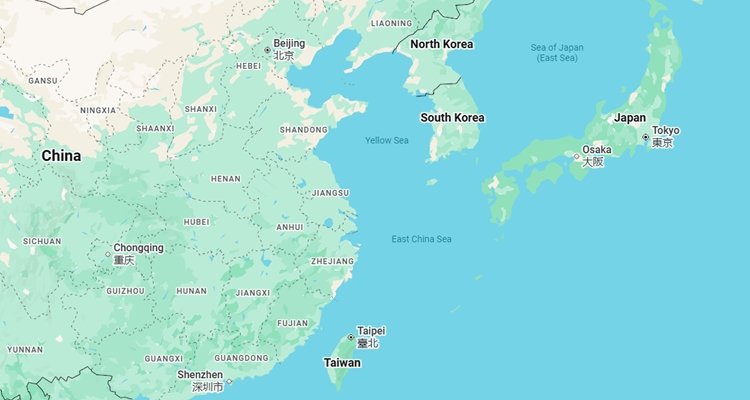
The zones reserved by China cover a total area larger than Taiwan’s main island, including offshore airspace to the north and south of Shanghai, according to information available from the U.S. Federal Aviation Administration. They extend from the Yellow Sea facing South Korea, south to waters of the East China Sea facing Japan.
The lack of announced exercises suggests the possibility of “a sustained operational readiness posture—and one that China apparently doesn’t feel the need to explain,” says Ray Powell. He directs Stanford’s SeaLight, which tracks China’s maritime activity.
Taiwanese officials believe that China’s off-limits zone is “ ‘clearly aimed at Japan’ as China looks to deter U.S. allies and erode American military influence in the Indo-Pacific region” and that China is “seizing an opportunity to increase its active military presence” while the United States is distracted by the war with Iran.
Also this week, Japan deployed long-range missiles capable of reaching China’s mainland as part of a military buildup on its strategic southwestern islands.
China has issued comparable reserved-airspace NOTAMs [Notice to Air Mission alerts] along the same stretch of coast at least four times in the past 18 months, but those were shorter—typically 3-day blocks—said Ben Lewis, whose research organization, PLATracker, documents Chinese military activity.
A National Review writer suggests that China’s “airspace gambit” is a “strategic signal…. Beijing appears to be revising its threat hierarchy to no longer view Japan as merely a supporting actor in a Taiwan contingency [i.e., invasion of Taiwan]….
“A NOTAM, repeated often enough, can change behavior as effectively as a naval blockade. If such measures are normalized, they will constrain Japan’s operational freedom and alter its risk calculations. Over time, this will erode Japan’s role as a reliable forward node in the U.S. alliance system.”
Which would make China’s forty-day no-fly zone another example of the sub-war warlike activity that we describe as gray-zone.
Also see:
SeaLight: “light up the maritime gray zone”
PLATracker: “Data-driven analysis of the People’s Liberation Army”