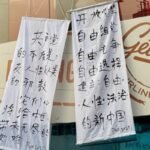
It was Hong Kong’s most devastating fire since 1953, an event recalling the Shanghai fire of 2010 that destroyed a 28-story high rise, killing an estimated 58 people.
On November 26, 2025, the world watched as seven apartment towers of the Wang Fuk Court went up in flames. These 1980s buildings not only lacked sprinklers; survivors say they also lacked functional alarms. Some residents learned that their building was burning from phone calls and TV broadcasts. About 38 percent of those residents were over 60. At this point, there seems to be no accurate death count beyond 150 or so.
The Hong Kong Labor Department visited the towers 16 times since renovations began in 2024. The warnings issued were not enough. As of November 28, there have been eight arrests.
NBC News says that the event “has ignited an upsurge in public anger that is testing Beijing’s control of the Chinese territory.”
As reported on Lei’s Real Talk, some Hongkongers view this tragedy as part of the “mainlandification” of the former crown colony.
Meanwhile…
As the towers burned in Hong Kong, videos circulated showing no fewer than eight ships wrapped in flames in Beihei Port, Guang Xi, on the mainland.
After midnight, early in the morning of November 27, again on the mainland, a train collided with construction workers doing major trackwork, killing 11 and injuring two more through lack of coordination and poor work practices.
Earlier that month, on November 11, the 758-meter long Hongqi Bridge, a prestige project, had collapsed into a Sichuan mountain gorge.
Even if we discount the events of November, it has been a disastrous year for the communists.
On August 22, 12 workers were killed when a section of a steel truss railroad bridge under construction in Qinghai Province fell into the Yellow River. Another prestige project. When completed, “it would be the world’s longest-span double-track continuous steel truss arch bridge.”
On May 19, the Fengyang Drum Tower collapsed without loss of life. Built in 1375, rebuilt in 1995, its restoration had been completed just last year.
On March 28, a 30-story office building in Bangkok, Thailand collapsed after tremors from a Myanmar earthquake reached the city. It was the only such building to collapse. Yet another prestige project, it had been constructed as part of China’s Belt and Road Initiative. By the end of April, 63 were known dead and 31 more were presumed dead.
Beijing’s reaction was predictable: “Chinese state-run outlets such as People’s Daily and CCTV both published reports on the collapse on the same day, but the links to the reports are no longer accessible. Searches for collapse-related keywords on Chinese social media platforms also yielded no results, suggesting that relevant content has been removed or suppressed.”
Mainlandification
In Hong Kong, Beijing is playing a different game, claiming that local standards are inferior to the mainland’s and that the former colony is insufficiently integrated into the surrounding regions with their superior codes and practices.
“Mainlandification” can mean many things. But here it refers to the lowered standards, corrupt practices, and shortcuts that result in what people call “tofu dreg” construction. Mainlandification appears to affect communism’s most prestigious projects as well as its most humble ones.
Looking ahead to 2026, Ecuador media are predicting that the Red China–built Coca Codo Sinclair Hydroelectric Plant may collapse. Completed in 2016, the plant, which “supplies nearly one-third of Ecuador’s electricity,” soon “suffered thousands of cracks, design flaws, and repeated equipment failures. Former Energy Minister René Ortiz blamed ‘poor-quality equipment and components provided by the Chinese contractor.’ ”
One tricky aspect of prestige projects is the risk of continuously humiliating yourself. Yet however bad the press, Beijing is not slowing down on the prestige projects. The Emerging Markets Investor blog has compiled an astonishing list.
China State Railway has ambitious plans to expand its high-speed rail network from 30,000 miles today to 37,500 in 2030 and 45,000 in 2035…. The rest of the world has 9,200 miles of high-speed rail….
The latest five-year plan (2026–30) calls for 140 new airports….
The Xiong’an New Area is an enormous urbanization project sponsored by Xi Jinping that showcases “Xi Jinping Thought” concepts, such as “ultimate Chinese modernization” and “high-quality productive forces.” The aim is to build a green, highly livable, and innovative “city of the future” with a “noble character and artistic temperament.”…
China is building a vast ‘Solar Great Wall’ that will power Beijing with green energy…. Expected to be finished in 2030, [it] will achieve a maximum generating capacity of 100 gigawatts, enough to meet the energy needs of Beijing. This project alone would represent 70% of the current capacity of the U.S.
Construction driven by political considerations—what could go wrong?
The question is whether Beijing can build faster than its projects collapse. □
James Roth works for a major defense contractor in Virginia.