Commentary at National Review about the stunning success of newfangled tech on the Ukraine battlefield briefly veers into Chinese territory. Not by reminding us that the Chinese government provides material support for the Russian invasion.
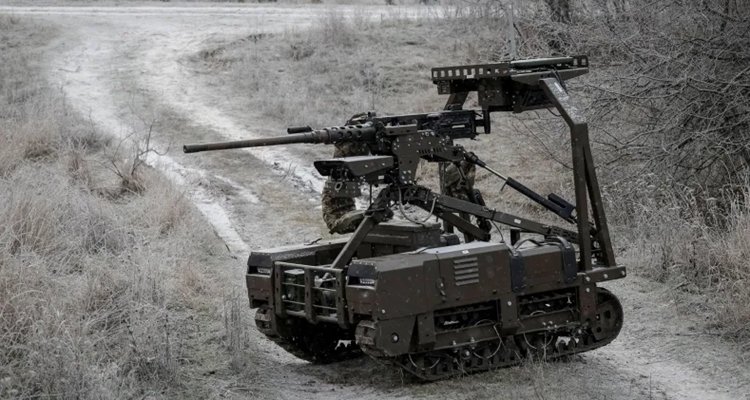
A couple of weeks ago, the Daily Mail reported that a machine-gun-armed, robotic Ukrainian ground vehicle—unmanned—“held off repeated Russian attacks on the eastern front for 45 days without a single soldier at the position” (January 16, 2026).
Russian troops were pinned down by relentless gunfire, believing they were facing multiple Ukrainian fighters. Even under the cover of fog and bad weather, they could not break through.
In reality, the resistance came from a single unmanned ground vehicle deployed by Ukraine’s Third Army Corps.
The robot, known as the DevDroid TW 12.7, is no bigger than a ride-on lawnmower but is armed with a .50-calibre M2 Browning machine gun.
It can be operated remotely from up to 15 miles away or navigate terrain using artificial intelligence.
Its commander said the machine defended positions that would normally require up to six soldiers, allowing Ukrainian troops to stay out of harm’s way.
Sooner or later, everything is related to everything else. But NR’s Andrew Stuttaford doesn’t have to stretch to find this implication for U.S. policy on China: “China is also known to be taking a keen interest in the new technologies emerging on the battlefields of Ukraine. Better sell them some more chips! (#sarc)”
It’s lucky that we have the #sarc tag to alert us to the fact that Stuttaford means the opposite, that we had better not sell the PRC more chips, including more sophisticated chips, lest they be used against us.
Wired notes that the Chinese government, supposedly reluctant to burden its domestic industry with imports of top-tier microchips, has “approved the sale of hundreds of thousands of Nvidia H200 chips to Chinese AI companies—the culmination of a dramatic shift in US tech policy.”
In order to reduce the self-harm inflicted by letting China have these chips, the U.S. has imposed “tightly defined performance bands” intended to “block the most powerful clustered systems,” better than no restriction. But the robotic guns can probably benefit from B+ H200 chips as well as from A+ H200 chips.
Limits of vetting
Another big Commerce Department restriction pertains to who in China may buy the H200. End users must be “vetted,” the rules demand; meaningless, since the vetted end users could then turn the chips over to unvetted entities or use the chips for unvetted purposes. The bureaucrats fashioning the regulations think they’re perfect if they have enough clauses and subclauses. But once the H200 chips are in China, that’s where they are.
ByteDance, Alibaba and Tencent are among the Chinese firms getting the H200. When the House Select Committee on the Chinese Communist Party was trying to persuade the SEC to delist Chinese firms tied to the CCP last May, the Committee noted that Alibaba was among the Chinese companies that “benefit from American capital markets while simultaneously advancing the strategic objectives of the Chinese Communist Party, including military modernization, surveillance, and forced labor.”
Committee chairman John Moolenaar later observed that firms like Alibaba have “no choice but to give up sensitive data on its customers and provide cybersecurity vulnerabilities to the CCP….”
Stuttaford is talking about guns and robotics on the battlefield that use microchips. But the People’s Republic of China is already warring on us and our allies in many ways, from surveillance to cyberattacks, that are enhanced by stolen or freely given Western technology, including chips. U.S. policy can slow and halt this assistance to the enemy by requiring itself to make sense.