In a recent post, we listed many of the assaults by PRC vessels on Philippine vessels that had occurred in 2026 as of the end of September. Various sites track or provide overviews of the PRC’s so-called gray-zone and other activities, like development of artificial islands, in the South China Sea and elsewhere. (War is the black zone. Gray-zone violence is belligerent and state-sponsored but not yet part of a full-scale or declared war.)
Asian Maritime Transparency Initiative (CSIS)
The AMTI site includes pages on Tracking Tensions at Second Thomas Shoal (carrying the story to early 2024); Shifting Tactics at Second Thomas Shoal (published August 22, 2024); Holding the Line: China’s Expanding Patrols around Scarborough Shoal (published June 16, 2025); and, focusing on several incidents in 2022, China Blocks Another Philippine Resupply Mission (published July 27, 2022).
This is an “interactive dashboard visualizing the latest ACLED data on maritime conflict and tension—including military and non-military activity, as well as coercive actions—in the South China Sea, Taiwan Strait, East China Sea, and Philippine Sea. Updated twice weekly on Wednesdays and Thursdays.” Accessing the dashboard seems to require registration. ACLED is the Armed Conflict Location & Event Data Project, an organization that collects and analyzes data about political violence, protests, and other political or military events.
South China Sea Data Initiative
The several goals of this project include creation of a “new, systematic dataset documenting conflict in the South China sea over the past decade, using a mix of qualitative and quantitative methods.” I downloaded some of the data. It doesn’t seem easy to work with. I’d also rather not have to download things from websites to see what information they have.
The many resources linked by this site include various databases and such texts as The Political Geography of the South China Sea Disputes: A RAND Research Primer, China Primer: South China Sea Disputes, the text of the United Nations Convention on the Law of the Sea (UNCLOS), and Defusing the South China Sea Disputes: A Regional Blueprint.
The last publication listed above, a CSIS report, seems based partly on fantasy. It includes this advice on how to defuse disputes: “Reaching agreements that are both effective and acceptable to all parties will require framing necessary compromises so that the South China Sea claimants can adjust their positions without violating domestic or international law.” The report also says that China and other states in the region should refrain from “occupying, inhabiting, or constructing facilities on currently uninhabited features.”
Yes, all that would be very helpful. Unfortunately, the Chinese Communist Party is not much interested in “framing necessary compromises” in the South China Sea, refraining from expansionist activities in the South China Sea, or avoiding violation of international law reasonably conceived. It does tend to stipulate that whatever it wants to do internationally is consistent with international law.
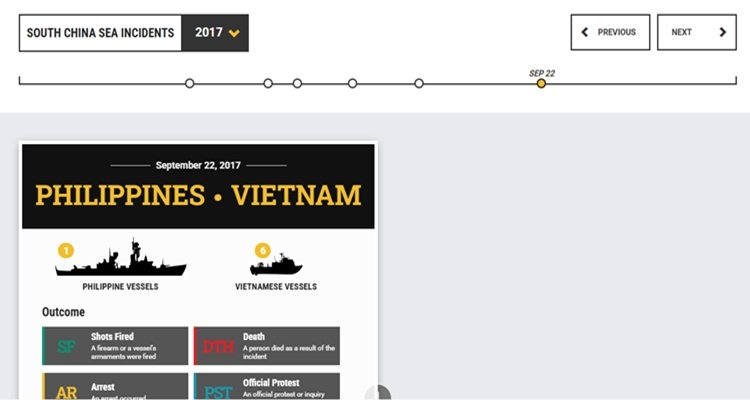
South China Sea Incident Tracker
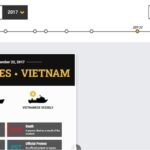
This is an archive of incidents that occurred between 2010 and 2020. “We created this project for CSIS as the first comprehensive tracker and online catalog of every maritime conflict occurring on the South China Sea. The CSIS team manually collected and recorded detailed reports as published by China, Taiwan, Indonesia, Vietnam and the Philippines. The incidents involve everything from fishing boats to military ships with a variety of outcomes that become increasingly deadly.”
Launching the project from the above-linked page takes you to a Chinapower.csis.org page, where a scrollbar enables you to access a timeline for a particular year.