In September 2024, Beijing imposed restrictions on the sale of drone components to Ukraine. The supply chain merely shifted offshore to third parties. In Malaysia, for instance.
Meanwhile, stories were told of Ukrainian success in drone development. A typical conclusion, from the Georgetown Forum: “Ukraine’s drone industry has demonstrated remarkable growth in drone production capabilities, technological advancements, and investments.”
Indeed, “Over the past three years, Ukraine’s drone industry has experienced a dramatic transformation. Once nearly nonexistent, it has evolved into a sector with skyrocketing production capacity, an expanding base of domestic manufacturers, and increasing technical sophistication of products.”
We’ve all heard variations of this, and it’s misleading. Ukraine has merely ramped up an assembly capability. The scale is impressive though.
Components
The Center for Strategic and International Studies notes that “Every drone involved in the war in Ukraine depends on [Red] China. From palm-sized quadcopters guiding artillery to long-range loitering munitions, nearly every unmanned system on both sides contains materials and components that originate in Chinese factories and refineries. Carbon fiber, rare-earth magnets, lithium-ion cells, and gallium-nitride chips are critical nodes in the [communist] Chinese supply chain underpinning the architecture of modern drone warfare.”
The Diplomat reports that “estimates suggest that up to 97 percent of components used in Ukrainian-made drones still come from [communist] China.”
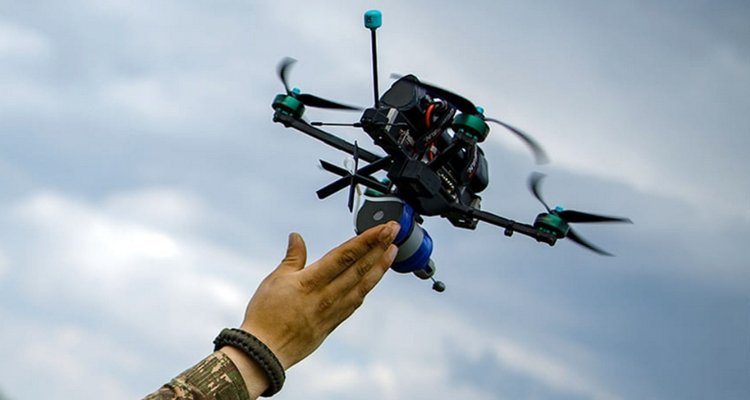
Ukrainian (and Russian and U.S.) drone production consists mainly of making some airframes in wood and plastic with the main work being component assembly. The CEO of defense giant Rheinmetall has dismissed the vaunted Ukrainian drone production as “housewives with 3D printers in the kitchen.”
Ukraine can go to Malaysia to stock up on drone components. But it’s not so easy for the United States, where the FCC, in December, banned future models of DJI drones and components. (DJI is Beijing’s powerhouse drone manufacturer and a favorite with hobbyists.)
Then, in June, the U.S. “banned imports of all new drones from [Red] China—and from Ukraine. While US drone operators may continue using drones already in the country, they cannot import newly developed drones without an exception granted by Defense or Homeland Security.”
This seems to work against Washington’s pre-existing Blue List program to preapprove certain drones and drone product sales to the U.S. government. Last month, the Defense Contract Management Agency, which manages the program, refreshed the process to make it “more transparent and conversational.” And faster.
Confusion? Cross-purposes? In any case, the Blue UAS list still names communist components, “including sensors, motors, and printed circuit board assembly. Analysts estimate the US would need at least five years to build sufficient lithium iron phosphate battery production capacity to meet military demand.”
Levels of unreadiness
Five years. And do we even understand what the need will be? Ukraine expends thousands of drones per month. Is this the military demand that U.S. planners are planning for?
The Pentagon recently announced loan guarantees of up to $820 million to start-up drone maker Performance Drone Works. What will that get us: 820 drones? And where will they get the components that we cannot or will not manufacture here?
Parts aren’t the only problem. Stories here and there suggest that our military is not ready for drone warfare on a number of levels.
Today’s less vulnerable drones are autonomous. No radio signals for enemies to jam. But as retired general John G. Ferrari writes, in the United States the debate about autonomous weapons policy “is dominated by concerns over moving too fast. Detractors warn that we may risk losing control of the systems themselves or the escalation dynamics they will impact.” In services dominated by politics and micromanagement, autonomy has to be anathema.
With respect to design and production, “The binding constraint is not the technology. The United States has the engineers and the tools. The problem is organizational. The Pentagon is used to buying platforms in orderly, linear stages across fixed categories. Algorithmic war machines do not sit still. They are fusions of hardware, software, data, and models that change constantly.”
Really Red tape
And so we have a totalitarian empire in China, the watchword for which is control, perfecting its “algorithmic warfare” as its republican rival stumbles through communist levels of red tape to try to keep up.
“The Houthi and Iran wars point to the reality that the United States has fallen behind in a game-changing area of combat,” concludes the vice chair of Business Executives for National Security. “It marks the first time since the beginning of World War II that the US military finds itself a major step behind…. If the United States cannot develop effective military solutions to these threats, conflict and multipolar instability will inevitably spread to other regions.”
It seems we need an algorithmic shift in culture to function under the new conditions of warfare. □
James Roth works for a major defense contractor in Virginia.