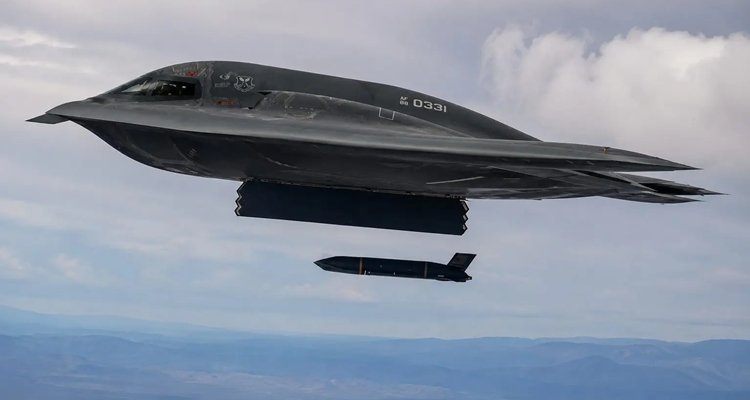
Late in June, the U.S. Air Force tested an anti-ship missile fired from a B-2 bomber, a stealth bomber. The missile being tested was an AGM-158C Long Range Anti-Ship Missile (LRASM), around since 2017 and not previously associated with the B-2. It gives the already hard-to-detect B-2 an additional safeguard: an estimated anti-ship missile range of 926 kilometers to use as standoff distance. Think of standoff distance as stealth enhancement.
KJ-3000, J-20, GJ-11
But, uh oh, we’re going to need some of that standoff distance. Because Red China has a new command and control aircraft, the KJ-3000, which (experts say) can track up to a hundred stealth targets at a time at a range of 360 kilometers. That would be 100 B-2s, if we had so many. B-2s better load up on LRASMs.
Beijing also fields a stealth fighter, the J-20, “operating alongside [ahem] the GJ-11 stealth attack drone.” Stealth attack drones—a novel category. At least we have some of those too.
One thing we don’t have are drones capable of catapult launch, flying drones that can be shot off of an aircraft carrier deck without disintegrating. On the other hand, Red China’s GJ-21 stealth drone “has been spotted with catapult launch gear, signaling a clear move toward carrier-based unmanned strike capability.”
Why wouldn’t a PLA Navy stealth drone likewise disintegrate if catapulted?
It depends on the catapult.
Steam or electromagnetism
U.S. aircraft carriers are equipped with steam-powered catapults which can launch drones but may damage them in the process, since drones are smaller, lighter, and more fragile than navy jets. The USS Doris Miller, an aircraft carrier scheduled for completion in 2033 or 2034, is instead being equipped with an electromagnetic catapult to deliver a smoother, less violent takeoff. Unfortunately, this tech is controversial in the U.S. Navy and may not survive the objections of the proponents of steam catapults.
Meanwhile, the Fujian, a PLA Navy aircraft carrier, demonstrated its working electromagnetic catapult last year by publicly launching various jets.
And have we mentioned “two massive stealth flying-wing drones” seen “parked at the [communists’] Malan test facility in Xinjiang”?
“One of the aircraft has an estimated wingspan of around 173 feet, comparable to the U.S. B-2 Spirit stealth bomber.” Hard to say what they are for. Any “details about its true designation or its manufacturer remain unknown.”
With respect to our B-2s, last month brought more troubling news. Maybe. “In a groundbreaking development that could reshape the landscape of modern warfare,” reports The Jurnals, “China has unveiled the world’s first programmable quantum radar.”
Puzzling to find “programmable” and “quantum” in the same sentence. Nevertheless, “It uses entangled photon pairs—particles of light that are quantum-mechanically linked, such that the state of one instantly influences the state of the other, regardless of distance. In this system, one photon is sent toward a target, while its entangled twin is retained at the radar source. Even if the transmitted photon is absorbed or scattered by a stealth aircraft, the retained photon retains information about the interaction, allowing the radar to reconstruct the target’s signature with remarkable precision.”
Uh…
This is blue-sky stuff that raises a lot of questions. How is one, first of all, going to acquire a stealth target in order to shoot a photon at it, if the target is stealthy? What is the range of your photon? How will you guide it? Quantum radar is supposed to “see through stealth like glass.” What is the output of the photon’s report back to the radar? It’s surely not a picture, temperature reading, materiel analysis, or image.
These stories are constantly coming out of Red China: some breakthrough experiments have produced results that will revolutionize this or that aspect of warfare. Harmless, perhaps. But they seem less so when you compare the agonizing development-to-deployment cycles of the Pentagon to the faster cycles of the People’s Liberation Army.
The response to this discrepancy seems to be copium. The U.S. Air Force’s China Aerospace Studies Institute tells us that Chinese communist perceptions of U.S. military development “are often incomplete or skewed, leading to an overreliance on hardware solutions, an underestimation of U.S. operational adaptability, and a framing of stealth as a technical rather than an operational problem.”
The author of the Institute’s study, Derek Ecklebe, says that stealth technology, “while expensive, complex, and important, is only part of the equation”; but the Red Chinese overemphasize it, and in developing countermeasures “present low-frequency radars, passive sensors, and terahertz sensors as potential solutions that could soon counter U.S. advantages. In practice, these systems face significant physical and operational constraints.”
That is, they don’t work, or they don’t work well.
One hopes neither side finds out. But in the meantime, the safer course is to take Red China’s stealth and anti-stealth tech seriously. □
James Roth works for a major defense contractor in Virginia.