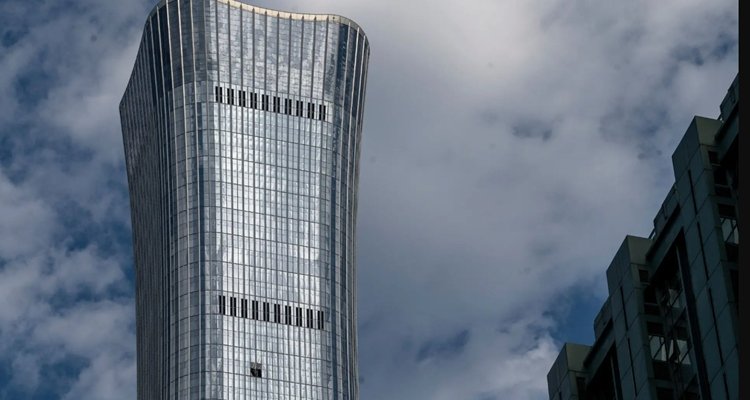
It was probably not an accident; also probably not a probing attack undertaken as prelude to a major assault on Beijing. That is, if we accept the word of the government of the Chaoyang district of Beijing, released after blanket censorship of the news and video of the crash apparently failed to erase all memory of the incident among the people of China.
On June 26, 2026, a small plane, described by the Chinese authorities as a “light sport aircraft,” crashed into “a high-rise building” at such-and-such location in the Chaoyang District, according to the official statement (as Google-Translated). So the first thing the statement does is gloss over the fact that the high-rise building which got hit is the CITIC Tower, at 109 stories and 1,732 feet the tallest building in Beijing.
The Chaoyang statement says that the pilot, surnamed Liu, a resident of Beijing, was
a freelancer who lived alone following a divorce; he had obtained a sport pilot license in 2021 and a private pilot license in 2024. On the afternoon of the incident, Liu took off from a general aviation airport in Pinggu District. He conducted both formation flying and solo flight; during the solo phase, he deviated from the designated airspace and lost contact with the airport before colliding with the high-rise building, resulting in his death at the scene. Liu had a history of chronic insomnia and anxiety, and his diary contained repeated references to “ending his life.” The investigation concluded that this was an incident endangering public safety caused by personal reasons.
Possibly all this is true. The account is so brief that it does not quote even a single sentence from the journal said to document the pilot’s desire to kill himself; in fact, if the translation is accurate, the few words “quoted” are a paraphrase of whatever it was he wrote in one or more journal entries. The divorce seems to be mentioned as a possible cause of despondency. When did it happen? A month ago? Ten years ago? Also, who is the pilot? Why isn’t he being fully identified? “Liu” is one of the most common last names in China.
The investigators were apparently not expected to learn what the plane’s flight, uninterrupted until it crashed into a window, might mean about the air defenses of the city that Xi Jinping and the Chinese Communist Party are most concerned to defend.
Breach
Foreign Policy says “Beijing Plane Crash Tests China’s Security State”: “The incident immediately raised questions about how the plane was flying through one of the world’s most controlled airspaces in the first place. China’s airspace is heavily restricted, with more than 70 percent of it under military control.”
The author suggests: “Without ruling out the possibility of a deliberate act, the more likely explanation is that a wealthy pilot obtained permission to fly over Beijing for sightseeing before a mechanical failure or pilot error caused the crash. If that proves to be the case, the political consequences will be severe for whoever bent the rules. There is almost certainly a political struggle going on within city leadership over who will be held responsible for this incident.”
The BBC reports: “Beijing enforces a permanent no-fly zone of roughly 100 sq km (39 sq miles) over its political core covering Tiananmen Square and Zhongnanhai, the heavily guarded compound where the country’s top leaders live and work.
“Describing the incident as a ‘massive security breach’, China analyst Bill Bishop wrote on X: ‘Not many more seconds of flying and [the crash] could have been at Zhongnanhai…. [That would have been] an earthquake in Beijing’s security system.’ ”
Also see:
Lei’s Real Talk: “One Plane. Four Mysteries. Why Doesn’t This Crash Add Up?”