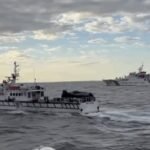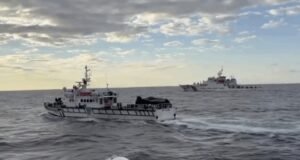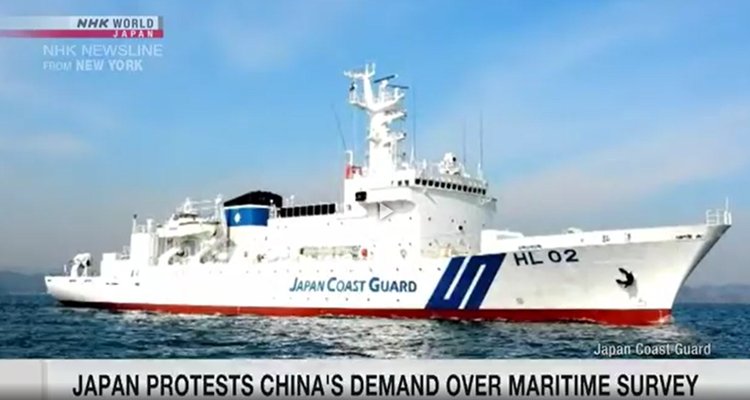
A ship of the Japan Coast Guard is conducting a survey about 290 kilometers from Okinawa, well within Japan’s exclusive economic zone as determined by the 1982 United Nations Convention of the Law of the Sea.
A China Coast Guard ship radios a demand that the Japanese ship stop its work and leave the area. A half hour later, the Chinese ship repeats the demand. The Japanese ship refuses, saying that it is conducting research in accordance with international law (NHK World Japan, July 1, 2026).
The Japanese government lodged a protest with China through a diplomatic route, saying that Japan is conducting a survey regarding its continental shelf and the Chinese side’s demand is unacceptable.
The Japan Coast Guard conducts a survey in the area every year. This is the sixth time since 2012 that a Chinese government ship has made such a demand.
The latest survey has been underway since June 15. The coast guard plans to continue the research until the end of July, as scheduled.
No ramming, no water cannons. Just an importunate and ludicrous order. Why did this incident—relatively minor unless the start of further harassments of the survey ship—occur? What the heck is China’s problem?
This particular demand has been repeated since 2012. The pattern is part of a large pattern. The People’s Republic of China routinely disregards any reasonable prohibitions against violating the rights and sovereignty of other countries.
Taiwan
The Chinese government is also probably still upset with the Japanese government because its prime minister indicated last November that it probably wouldn’t just stand by if the PRC attacks Taiwan.
In response, the PRC has filed a diplomatic protest with Japan, condemned Japan, threatened to decapitate the Japanese prime minister, complained about Japan to the United Nations, warned Chinese against going to Japan as tourists or as students, cancelled cultural exchanges with Japan, suspended imports of seafood from Japan, tightened or imposed restrictions on exports of dual-use goods and rare earths to Japan, conducted more military exercises and patrols near Japan, and ramped up the anti-Japan propaganda about the Japanese militarism as manifested by…what?
By the fact that when Prime Minister Takaichi was asked during a parliamentary session “whether a ‘Taiwan contingency’ involving a Chinese naval blockade would qualify as a ‘survival-threatening situation’ for Japan,” she replied: “If warships are used and other armed actions are involved, I believe this could constitute a survival-threatening situation.” This means that Japan would be justified in deploying its Self-Defense Forces. The doctrine is not new, just a little more openly articulated by an incumbent prime minister than usual.
Taiwan is about 70 miles from the edge of Japanese territory.
Law of the Sea
Britannica: “According to the 1982 convention [the United Nations Convention on the Law of the Sea], each country’s sovereign territorial waters extend to a maximum of 12 nautical miles (22 km) beyond its coast, but foreign vessels are granted the right of innocent passage through this zone. Passage is innocent as long as a ship refrains from engaging in certain prohibited activities, including weapons testing, spying, smuggling, serious pollution, fishing, or scientific research….
“Beyond its territorial waters, every coastal country may establish an exclusive economic zone (EEZ) extending 200 nautical miles (370 km) from shore. Within the EEZ the coastal state has the right to exploit and regulate fisheries, construct artificial islands and installations, use the zone for other economic purposes (e.g., the generation of energy from waves), and regulate scientific research by foreign vessels. Otherwise, foreign vessels (and aircraft) are entitled to move freely through (and over) the zone.”