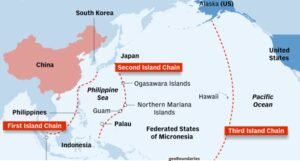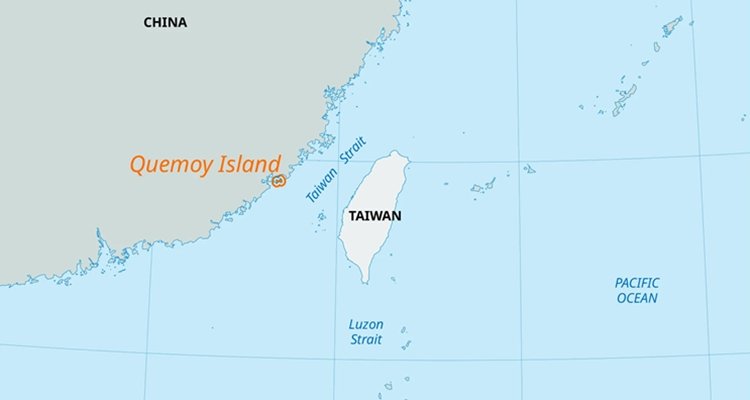
The “etc.” above refers to the other islands. Taiwan is a big island in the Republic of China, and there are dozens of smaller islands that are also governed by Taipei. Whether it would make sense for the People’s Republic of China to seize any of the islands if it ever attempted conquest of Taiwan is one question discussed in a recent Foreign Affairs article, “The Mirage of China’s Military Edge: Panic Is Misguided—and Counterproductive” (July/August 2026).
Answer: not much sense, because although the ROC would be unable to prevent the People’s Liberation Army from occupying some of the islands, “none is vital to the Taiwanese economy. Nor does Chinese occupation affect Taiwan’s defense of the main island.”
The author, Dennis Blair, is a former commander in chief of the U.S. Pacific Command (1999 to 2002). From 2003 to 2007 he was “Senior Mentor to Taiwan’s annual self-defense exercise.”
Worst-case scenario
Blair’s first judgement is that it would be disastrous if the PRC were to forcibly “take and hold” Taiwan. (There can be no non-forcible taking and holding of Taiwan, though; surrender would be the result of force, and the ensuing tyrannical CCP governance of the Taiwanese would entail all the same coercions deployed to repress people on the mainland.)
A nearly $1 trillion economy would leave the free-market system and be incorporated into China’s state-directed, mercantilist one. A vibrant democracy nurtured and defended by the United States for many years would be snuffed out. American power and influence would be gravely diminished in East Asia, and China would become the region’s dominant power. Other governments there would be pressured to accommodate China’s political, economic, and even territorial demands. Beijing would certainly insist that they kick out U.S. forces. China’s global ambitions, meanwhile, would only grow.
Next judgment: successful conquest of Taiwan is unlikely despite China’s military buildup (“not as dazzling as it may appear”).
Methods of attack
A surprise attack would not really be a surprise, and just a few days of warning would give Taiwan time “to move troops and set obstacles on the beaches and landing fields it has long been preparing to defend. The United States, too, would have more than enough notice to arm and deploy its substantial naval and air forces in the region and strengthen the defenses of its bases before the invasion could begin.”
A blockade would likely be foiled in part because the United States and “countries in the region friendly to Taiwan would most likely help it lift a sea blockade by organizing a convoy system.”
Air and missile strikes would cause damage but not enough.
With its present capabilities, China can strike a variety of targets in Taiwan, and Taiwanese defenses can only partially blunt the attacks. The most likely targets would be military bases. Yet the damage would be limited because Taiwan has buried many of its important military sites and developed plans to disperse and conceal mobile systems such as aircraft, missile launchers, and armored vehicles. Strikes against critical infrastructure, industrial sites, or government facilities are also possible. But they would damage property and kill or injure the citizens that China claims as its own, encouraging international opposition to China’s actions and hardening Taiwanese determination not to surrender. American campaigns against Serbia in 1999 and Iran this year have shown the limits of relying on airstrikes to bring about rapid capitulation to political demands.
Would it be practical to try to “decapitate Taiwan’s leadership and then bring about a coup”? “Success would depend on its ability to neutralize Taiwan’s security forces, both military and police—a difficult feat.”
However China wages war on Taiwan, its operations “would almost certainly draw a strong [and damaging] global response.”
The future
Technological developments are also on Taiwan’s side, Blair feels.
For at least the next decade, favorable trends in hypersonic weapons, drone systems, electronic warfare, and cyberwarfare put the United States and its allies and partners in a strong position to deter China from an attack on Taiwan. China would need much greater military expenditures to overcome these advantages. Yet these positive trends are not self-sustaining. The technology of warfare does not stand still, and maintaining deterrence will require investment in innovation, particularly in space operations and artificial intelligence systems. Taiwan, the United States, Japan, and the Philippines must continue to commit resources, engage in effective military planning and exercises, and respond to China’s aggressive actions.
In sum, a successful invasion of Taiwan is unlikely if Taiwan and others “stay the course.”
Also see:
StoptheCCP.org: “What War Between Beijing and Taipei Would Really Mean”
StoptheCCP.org: “Three Ways Red China Might Not Grab the Republic of China”
TWZ: “Air Force Discloses B-2 Can Launch Stealth Anti-Ship Missiles In Surprise Announcement”
“Integration of the AGM-158C offers a huge boost in capability for the B-2, creating a penetrating fleet-killing platform that could be especially valuable in a future high-end fight in the Pacific against China.”