As Secretary of War Pete Hegseth tells U.S. allies or quasi-allies that “the time for free riding is over” and that “being an ally is not a one-way street,” an admonition we’ve heard before from the Trump administration, Japan has been moving to further strengthen its ability to defend itself from the People’s Republic of China and other adversaries (Politico, April 24, 2026).
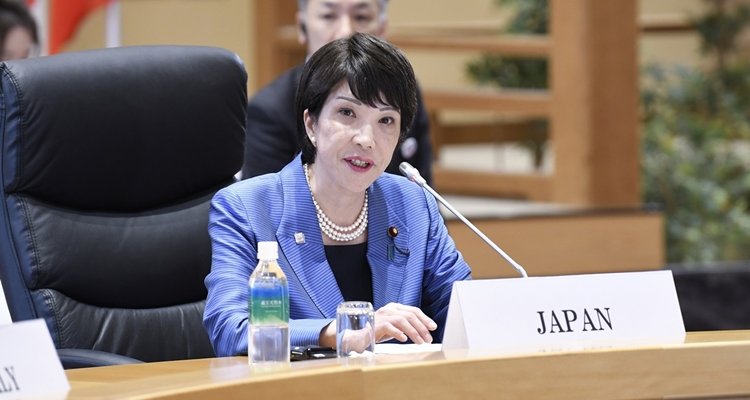
In the past eight days the government of Japanese Prime Minister Sanae Takaichi has pushed for changes to Japan’s National Security Strategy to extend naval operations to regional sea lane defense, talked up tighter NATO ties with visiting coalition representatives and lifted curbs on arms exports. Those moves come as Beijing makes increasingly aggressive territorial claims, from the disputed Senkaku islands to the Japanese island of Okinawa….
The Iran war has made [Japan’s worries about the United States] more concrete. The Defense Department informed Tokyo last month that depleted U.S. munition stocks will delay delivery of some of the 400 Tomahawk missiles Japan ordered in 2023, Japan’s Asahi Shimbun newspaper reported last week….
Trump also ran into the limits of Japan’s restrictions on its military last month, when Takaichi declined Trump’s request that Tokyo send forces to help secure the Strait of Hormuz due to constitutional restrictions.
The White House says it welcomes Japan’s moves to bolster its defensive capabilities. “President Trump has encouraged all of our allies to take greater responsibility for their own defense,” White House spokesperson Anna Kelly told NatSec Daily.
Japan’s “peace constitution” states that “the Japanese people forever renounce war as a sovereign right of the nation and the threat or use of force as means of settling international disputes. In order to accomplish [this] aim…, land, sea, and air forces, as well as other war potential, will never be maintained.”
Interpretations
Self-defense being an unavoidable task, Japanese governments have long read the constitution in such a way as to enable the state to in fact maintain a Ground Self-Defense Force, a Maritime Self-Defense Force, and an Air Self-Defense Force: the Japan Self-Defense Forces. Now the Japanese government is interpreting the actual requirements of self-defense more liberally.
Late in 2025, Naval News reported that the cabinet of Japanese Prime Minister Sanae Takaichi “approved $58 billion (9.04 trillion yen) defense spending for fiscal year 2026, as Tokyo faces growing military pressure from three nuclear-armed neighbors—China, North Korea, and Russia—and U.S. calls for higher defense outlays.”
On March 31, 2026, The Asahi Shimbun reported that Japan’s Ground Self-Defense Force was now “deploying long-range missiles that can reach targets in enemy territory and will serve as a pillar of Japan’s counterstrike capabilities.
“Since their inception, the Self-Defense Forces have maintained an exclusively defense-oriented posture…. However, under revisions to security documents, if Japan now determines that an attack from an adversary is imminent, the SDF can strike missile bases and naval vessels within the opponent’s territory.”
On April 21, 2026, Reuters reported that Japan had begun scrapping “restrictions on overseas arms sales and opening the way for exports of warships, missiles and other weapons. The move aimed at strengthening Japan’s defence industrial base marks another step away from the pacifist restraints that have shaped its postwar security policy. It has been made in tandem with efforts to deepen ties with other nations in Asia to counter China’s growing regional influence.”
The PRC’s treasure
Also in April, in response to Takaichi’s support for amending the constitution, “About 30,000 people gathered outside parliament last week for one of more than 130 protests nationwide.” Among the chants: “Trump, step down!” and “The pacifist constitution is Japan’s treasure.”
China, Russia, North Korea are doubtless also in favor of pacifism—for others.