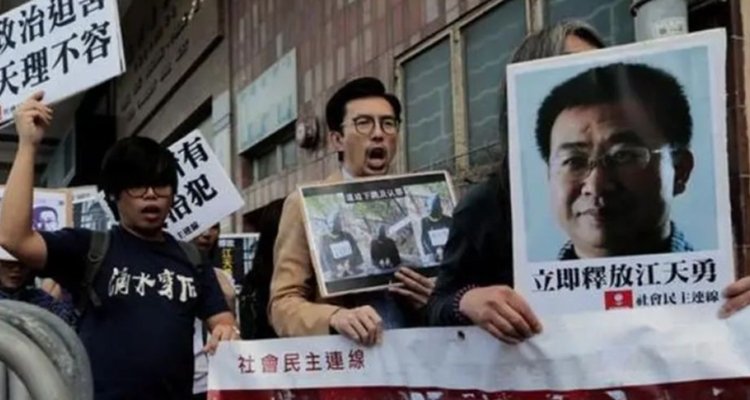
This is a slightly misleading headline: “China’s Five-Year Sentence on Xie Yang Signals Crackdown on Rights Lawyers” (Impact International, March 24, 2026).
The Chinese Communist Party “signaled” the contemporary assault on rights lawyers, in the sense of conveying notice or warning of it, more than a decade ago with the mass arrest of such lawyers starting on July 9, 2015 (“709”). The article itself notes this history. Xie Yang is the latest victim.
The Changsha Intermediate People’s Court sentenced prominent human rights lawyer Xie Yang to five years in prison on March 23, 2026, for “inciting subversion of state power.” This verdict, based on his online remarks and interviews criticizing government policies, follows over four years of pretrial detention since January 2022, with 13 extensions that defied legal norms.
The case underscores China’s state policy of silencing dissent through vague national security charges, violating both domestic Criminal Procedural Law—articles 33-35 on defense rights and 188 on public trials—and international fair trial standards.
Xie Yang, aged 54, has defended Christian activists, pro-democracy advocates, and land-grab victims, making him a repeated target. His secret October 2025 trial excluded family notification until afterward and barred chosen lawyers, rendering the process a sham that exemplifies broader suppression of human rights activism….
The Xie Yang sentence intensifies a crackdown [begun in] the 709 era [in 2015], where disbarments, detentions, and forced recantations have gutted human rights advocacy. By criminalizing speech under subversion laws, Beijing enforces a state policy that equates criticism with sedition, chilling online dissent amid tightened internet controls and foreign agent regulations.
The four years of pretrial detention and the 13 extensions—and the routine imprisonment of persons known to be innocent of any crime—defy the legal norms in force elsewhere in the world but not the norms of the Chinese state. This state has long asserted the propriety of unlimited arbitrariness in the exercise of power.
The presumption doesn’t have to be written down or explicitly stated to be in force. It’s an operating procedure that, absent any supervening edict issued by a more powerful agent of the same dictatorial authority, can at any time render nugatory any law or rule enunciated in a statute or constitution. This is true even though the PRC government is always issuing new laws to pseudo-justify past and future assaults on the innocent. An injustice not yet covered by the fig leaf of some law exposes the state to no risk of effective prosecution. Those who object are the ones at risk.