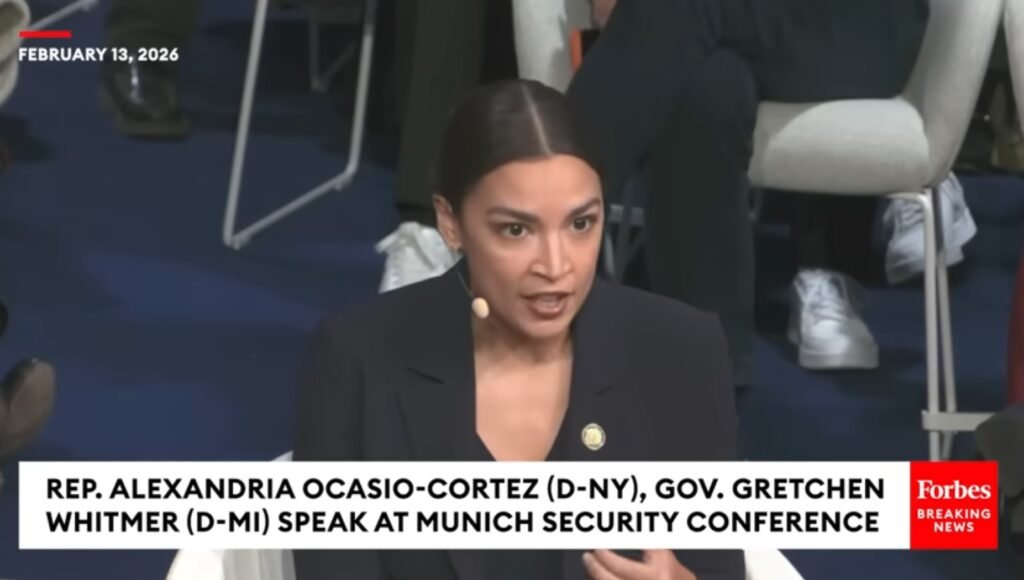
Nobody has accused mega-left Congresswoman Alexandria Ocasio-Cortez, aka Occasional-Cortex, of being a mastermind when it comes to foreign policy or anything. The aspiring senatorial and/or presidential candidate is a walking disaster. Everyone knows it, and there is certainly no need to add to the bad reviews garnered by her recent performance at the Munich Security Conference.
On the other hand, her opining on foreign policy there, certainly vis-à-vis Red China and Taiwan, has been underreported by some major news outlets.
Next chapter
Put it this way. It can’t hurt to add to the bad reviews given, for example, this Associated Press curation of AOC insight in Munich (February 13, 2026):
Her attendance at the conference, she said, was meant to show support for international liberal values.
“We are ready for the next chapter, not to have the world turned to isolation, but to deepen our partnership on greater and increased commitment to integrity to our values,” she said at a roundtable.
Ocasio-Cortez said she identified with voters who had defected from traditional left-of-center parties in Europe and the United States for populist hard-right parties. She said her frustrations with a Democratic Party “that championed special interests, the elite” is what had pushed her to run for office.
“Domestically and globally, there have been many leaders who’ve said ‘We will go back’. And I think we have to recognize that we are in a new day and in a time,” she said, adding “That does not mean that the majority of Americans are ready to walk away from a rules-based order and that we’re ready to walk away from our commitment to democracy.”
This is the best the Associated Press could do and AP still couldn’t quite rescue her. Being “ready for the next chapter” is supported. “Greater and increased commitment to our values” (oops, I meant “…to integrity to our values”) is supported. “Going back” is opposed. “Recognizing new day and time” is supported. “Majority of Americans” are supported, and assigned the view that they are in favor of democracy—unlike AOC’s anti-socialist political opponents. If specifics were rocks, nobody mulling these words would be at risk of getting buried in an avalanche. But one can gather that socialism and central planning are good, freedom and markets bad.
Last night I got a telegram from Paul Jacob, publisher of StoptheCCP.org.
AOC likes China better than U.S.
Paul alerted me to the fact that before she got around to stumblingly trying to answer a question about what U.S. policy should be in relation to Taiwan if the People’s Republic of China were to attack Taiwan, Alexandria Ocasio-Cortez in Munich “spoke forcefully about the U.S.-China relationship. She is very understanding of China and frankly had nothing bad to say about the regime. And she attacked the U.S. for not having engaged in massive state infusions of cash ‘investments’ like that grand old Chinese Communist Party does. AOC likes China better than the United States.”
Come on Paul. No persons could be that bad on China! Or…might they be? Well, here’s the relevant section of a video of the proceedings (go to 28:40).
No [to a statement about how China is “a very real threat” to Americans]. I think China is, of course, an ascending global power growing very quickly, acting in its own self-interest. And oftentimes in Washington, there’s this frame between conflict and competition.
I think sometimes depending on what’s happening, that rhetoric can get a little conflict-driven. And I think that it’s really a question of competition, and to the governor’s point, fair competition. But when I think about that, I think about how the United States, if you want to assert oneself as a global competitor, the kinds of things that one would do in order to really assert that position is investments in science and technology, which we are gutting our NIH.
We are gutting our health science research. We are cutting the very things that make us a global power in that respect in terms of government and public-funded research, which is what allows innovation in a more broad sense as opposed to privatized research. We, an ascendant global power would invest heavily in innovative energy solutions [which the market, “privatized research,” cannot possibly]….
And the United States at this point, instead of expanding our energy mix [by compelling reliance on unreliable wind and solar], we are actively narrowing our energy mix to become increasingly more reliant on fossil fuels [merely because they are reliable]. Instead of, in contrast to what you see is happening in China, yes, they burn a very large amount of fossil fuels, but they have also invested dramatically in wind and solar and in energy innovation.
Next question: “Would and should the U.S. actually commit U.S. troops to defend Taiwan if China were to move?”
Occasional-Cortex:
Um, you know, I think that, uh, this is such a…a…you know, I think that this is a, um…. This is, of course, a very long-standing, um…policy of the United States. [What is the “long-standing policy” of the United States? Strategic ambiguity? Definitely coming to Taiwan’s defense if it is attacked? Or what?] Uh…and I think what we are hoping for is that we want to make sure that we never get to that point. And we want to make sure that we are moving in all of our economic research and our global positions to avoid any such confrontation and for that question to even arise.
Just never get to that point. Just never let the question even arise. Just let it all go away. Get Trump and Xi on the hotline.