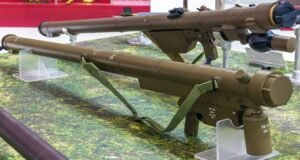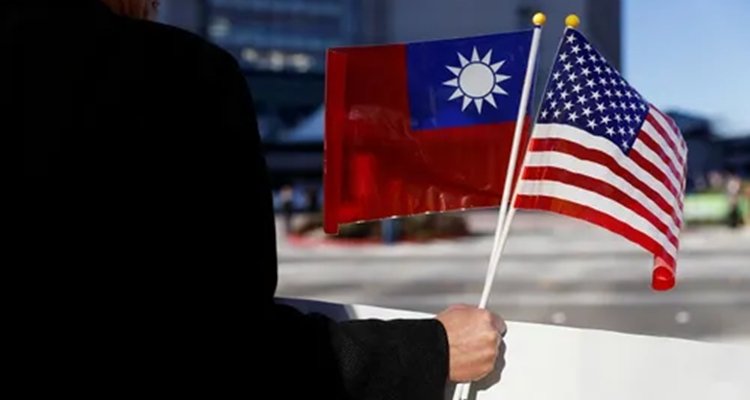
The United States agreed to sell some $11 billion in arms to Taipei, and the ruling government of the Republic of China agreed to buy them.
But there’s a problem. The legislature isn’t cooperating. The legislative majority, which consists of a coalition of Taiwan People’s Party lawmakers and Kuomintang lawmakers, has set aside the ruling Democratic Progressive Party’s defense budget and advanced a TPP-proposed budget that is “narrower in scope” (Focus Taiwan, January 30, 2026). The latter budget covers
only five of the eight weapons systems approved for sale by the U.S. Department of State in December and [sets] a spending cap of NT$400 billion.
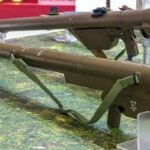
The TPP’s proposal allocates NT$126.7 billion for 60 M109A7 self-propelled howitzers along with 4,080 rounds of precision munitions, and NT$127.6 billion for 82 HIMARS multiple rocket missile systems.
It also covers anti-armor loitering munition systems [and various missiles and missile launchers]….
However, several preapproved U.S. weapons sales present in the Cabinet’s special budget are omitted, including US$1.01 billion for tactical mission network software, US$96 million for AH-1W helicopter parts, and US$91.4 million for Harpoon missile support.
Funding for partnerships with the local arms industry, procurement of 200,000 drones, and the T-Dome multilayered air defense system to protect Taiwan against Chinese missiles are also absent.
Reacting to developments on Friday, the final day of the current legislative session, Cabinet spokesperson Michelle Lee said that the KMT and TPP’s “politicizing” of the issue could delay Taiwan’s weapons procurement plans and negatively affect its efforts to build combat readiness.
Perhaps politicians and others could stop accusing their political opponents of politicizing issues that are political. How robustly Taiwan will be able to prepare to defend itself from an attack by the mainland in consequence of legislative happenings is a political issue. How much the ROC will be allowed to spend, and on what, to defend itself is a political issue. Legislative wranglings are political. Michelle Lee’s better argument is that KMT and TPP lawmakers are undercutting Taiwan’s ability to defend itself.
Not helping
In the February 6 installment of its National Security Daily, Politico suggests that “Capitol Hill is losing patience with Taipei.” U.S. lawmakers are worried that “Taipei isn’t going to be able to buy weapons the U.S. has pledged to help the island defend itself from Beijing.”
The reason for the worries is stated above, but Politico reports the bottom line in USD amounts. “Taiwanese President Lai Ching-te has been locked in a battle with opposition parties for legislative approval of a sharp increase in defense spending. And last week, Taiwan’s legislature voted to slash Lai’s $40 billion special defense budget to $12.6 billion. Without those extra funds, it will be difficult for Taiwan to buy $11 billion in U.S. arms the State Department approved for sale to Taiwan in December.”
Politico also reports that U.S. senators like Roger Wicker, Republican, would “like to help [the Taiwanese] realize the seriousness of their situation, and if they want the free world and their allies to provide assistance, they need to do their part.”
Another senator, Ruben Gallego, Democrat, says: “If the American public feels that the Taiwanese people themselves did not do everything they could to prepare themselves for an existential situation, it’s going to be harder for us to make arguments for our involvement in a very dangerous situation for a country that’s [etc.]…”
Wicker, Gallego, and the other senators condescending to urge the ROC government to accept the U.S. package must know about the possibility of political conflict in foreign lands, since they are embroiled in such conflict every day in DC. Let them make calls to the KMT and TPP leadership.
Whether such lobbying would be effective or even tolerated is highly uncertain, though. At the moment, the Kuomintang, dominant partner in the KMT-TPP coalition, is wooing and being wooed by the Chinese Communist Party.
KMT-CCP forum
Chosun Daily reports on the recent resumption of the Kuomintang-Communist Party Forum—after a ten-year hiatus. The forum had been suspended in 2016 “after the pro-U.S., anti-China Democratic Progressive Party took power.”
The KMT sat still to listen to stuff like this, from Song Tao, director of the State Council Taiwan Affairs Office: “The Taiwan Strait situation is complex and severe… We must adhere to the 1992 Consensus…and oppose Taiwan independence.”
Which was only affirmed by the vice chairman of the Kuomintang, who perhaps does not follow the news of what is going on in the Taiwan Strait: “The two sides of the strait should cooperate to earn global wealth rather than create a situation where confrontation benefits foreign powers. Cross-strait relations must prioritize ensuring the welfare of the people, uphold the 1992 Consensus, and oppose Taiwan independence.”