As they’re saying online, Xi Jinping has gone full Stalin.
He reduced Communist China’s Central Military Commission membership from seven, the total number allowed, to just two: Chairman Xi himself and one political commissar. This means that Xi has sole, personal control of the military.
On Saturday, January 24, 2026, Beijing’s Ministry of Defense announced that two other members, generals Zhang Youxia and Liu Zhenli, were under investigation.
Zhang Youxia and Liu Zhenli
There seemed to be, at the time, some subtle distinction between being fired and being under investigation. For instance, Zhang’s and Liu’s photos and information had been left on official websites because as of Tuesday, January 27, all five theatre commands of the People’s Liberation Army remained silent, having made no announcement about the changes.
Also, by the 27th no government department, neither in the People’s Liberation Army nor in the civilian government, had announced meetings to endorse the investigation or to denounce corruption. In her Real Talk video series, Lei surmises that people don’t want to pick a side. Even though silence is also picking a side—it’s detrimental to Xi’s power.
Newsweek gingerly asks: “Was this a political coup by Chinese leader Xi Jinping against a powerful rival? Or was it just another push to clear out corruption…?”
Nothing political here, comrade, just a little crime busting. Or maybe both?
The [Ministry of Defense] announcement was quickly followed by a longer editorial in the People’s Liberation Army Daily that accused the two [Zhang and Liu] of “serious” corruption. The article—likely approved by Xi himself— also accused the pair of failures that suggested the problem may be deeply political.
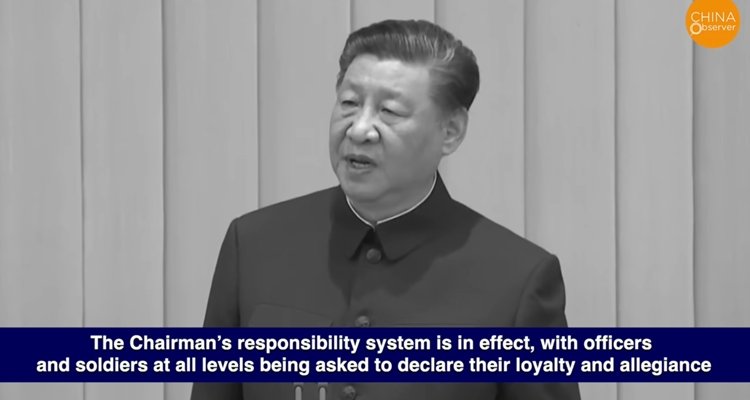
Zhang and Liu had “seriously trampled on and broken the CMC chairman responsibility system,” the newspaper said, a reference to power distribution at the top.
They had “seriously attacked the political and ideological foundation for the unity and progress of all officers and soldiers throughout the military.” Investigating the two would “further rectify the political foundation and purge ideological toxins and evils.”
The language suggests that Zhang and Liu are accused of undermining Xi’s authority, perhaps forming a clique, maybe even moving against Xi.
Certainly the rumor mill fastened on the last point.
Coup and counter-coup?
The China Observer reports the rumor that Zhang had used a Military Commission meeting to mobilize a surprise attack but that the plan was detected. Another rumor says that the two generals had been planning a coup but were betrayed hours before the operation launched.
As late as January 28, rumors were swirling that Zhang had been rescued by Liu.
Newsweek quotes Francesco Sisci, director of the Rome-based Appia Institute think tank: “When you see such a sweeping purge [over time] that goes to scores of generals being demoted or put under investigation, it’s not something minor—it must be extremely serious. So, I surmised there had been an attempt at a coup, because of the size of it.”
But the independent commentator David Tsai has an interesting take on the coup rumors and the arrests. There was no last minute ad hockery, he says. These arrests were “carefully planned and carried out at the Central Party School by the Central Guard Bureau the operation headed by Liu Jinguo from the Central Commission for Discipline Inspection.”
This would support the views of Ja Ian Chong of the National University of Singapore, who asserts that there was and is no threat to Xi because he is “impossible to oppose within the system.”
This brings us back to motive for the arrests.
Newsweek took note that according to The Wall Street Journal, “military officers in Beijing were briefed that Zhang had leaked technical data on China’s nuclear weapons to the United States….
“But several experts cast doubt on that theory….
“ ‘There are a thousand reasons to frame Zhang,’ Henry Gao, a law professor at Singapore Management University, wrote on X. ‘Not a single one of those reasons has anything to do with actually leaking state secrets to the US.’ ”
The source
The video site China Uncensored was more scornful. Regarding the alleged leak of nuclear secrets, the Journal says that a retired General Gu Junshan is the source for this. China Uncensored explains that he is the general manager of the China National Nuclear Corp. “Source” is too strong a word: Gu learned of the spying accusation from “people familiar with a high level briefing on the allegations.”
In other words, Gu is a person who is familiar with people who may be familiar with a briefing. A cynical newspaper saying applies here: “The story is too good to check on the facts.”
As for the Red China reporting by the Wall Street Journal, David Tsai says that the Journal is the “top-tier mouthpiece of the regime’s external propaganda”; not a badge of honor.
And as enmeshed in all the rumors as even the humblest blogger. □
James Roth works for a major defense contractor in Virginia.