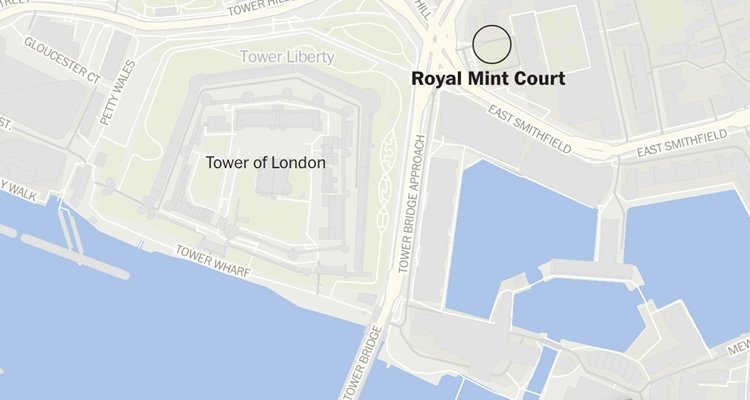
As British Prime Minister Keir Starmer was preparing to meet with Chinese dictator Xi Jinping, in the American press British MP Iain Duncan Smith was blasting the Starmer government’s decision to approve a controversial mega embassy to be built at the site of the former Royal Mint, “a decision that betrays Prime Minister Keir Starmer’s weakness” (The Washington Post, January 25, 2026).
Betrays? Say rather that the decision confirms Starmer’s weakness. The word “betrays” seems to suggest that the weakness was hidden or obscured up to now and that it took this particular decision to reveal the extent to which the premier is willing to submit to and enable the Chinese Communist Party.
The weakness has also been evident in Starmer’s recent refusal, on flimsy grounds, to proceed with the trial of two Brits caught spying on Parliament for China. And in his push to hand over the Chagos Islands, which contains an important UK-U.S. military base, to China-friendly Mauritius. And in other policies.
Mega weakness
Iain Duncan Smith (“Ignoring security threats, Starmer caves to China on mega-embassy”:
Over the past year and a half, the government has insisted that Britain’s security services can cope with the presence of a super-embassy (at 215,278 square feet, the largest in Europe) serving the interests of the Chinese Communist Party. Yet, on the very day the planning permission was announced, Ken McCallum, director general of the domestic security service MI5, and Anne Keast-Butler, head of the electronic intelligence agency GCHQ, signed a joint letter to ministers warning that “it is not realistic to expect to be able wholly to eliminate” security threats posed by the embassy.
Their caution is not surprising. Aside from the obvious increase in surveillance risks from such a mega-complex in the heart of London, there is the added concern that the Chinese government will be better able to menace Chinese dissidents. This is the same Communist government that trashed the Sino-British agreement transferring Hong Kong to China’s rule in 1997 and imposed a draconian national security law in 2020. It was under this law that the Chinese government began to arrest and persecute thousands of peaceful democracy campaigners….
As it does elsewhere in the world, the Chinese government operates “police stations” in Britain for interrogating and menacing those who have fled its rule, to coerce them to return to Hong Kong. The CCP has also offered bounties, the equivalent of $128,000, for information leading to the capture of Hong Kong dissidents in Britain and other countries.
When these tactics fail, the Chinese government has turned to violence. In late 2022, Bob Chan, a Hong Kong dissident who had fled to Britain, was dragged into the Chinese Consulate in Manchester and beaten. His attackers reportedly included the consul general….
It is also unbelievable that on the day the housing secretary, Steve Reed, released his grant letter giving China planning permission, he included a weak statement saying strategically vital telecommunications cables—which run right by the super-embassy site and have caused deep concern from many British allies—should not present a problem as long as the embassy is used in a lawful way. [From the Reed’s 240-page letter: “There is no suggestion that the operational development permitted by any grant of planning permission would interfere with the cables, nor that a lawful embassy use of the site would give rise to any such interference.”]
Really? How could he not notice that China actively conducts unlawful espionage in Britain directed at our institutions, intelligence services and Parliament—as well as individuals, including myself, who have been sanctioned for criticizing the CCP over human rights abuses?
Reed probably did notice all that, Smith. But Reed is saying that as long as the CCP personnel running the mega embassy confine their activities to what Reed’s paperwork allows, the data cables are safe from their interference. If the CCP obeys UK law, UK law will be obeyed by the CCP. This, I think, is indisputable.
Small wonder that the 2023 parliamentary Intelligence and Security Committee report concluded that China has been able “to successfully penetrate every sector of the UK’s economy.” This embassy decision will add massively to that vulnerability.
What is the answer to this and other relevant facts detailed in Smith’s commentary? “The Chinese Communist Party has turned over a new leaf”? “Just get Keir Starmer in a room with Xi Jinping so Starmer can work his magic”? Statements by the Starmer government ignore all pertinent context.
One of the benefits of the UK’s kowtowing to the Chinese Communist Party is to be increased trade.
Starmer says: “It doesn’t make sense to stick our head in the ground and bury it in the sand when it comes to China. It’s in our interests to engage,” diplomatically and economically.
What if engagement entails burying one’s head in the sand? What if pursuing some interests at the expense of others is suicidal? What if Starmer has a Humpty-Dumpty idea of the meaning of words?
Real perspective
On the plane with Keir Starmer on his way to China were some fifty business leaders, including businessman William Butler-Adams. Butler-Adams is thrilled by the business opportunities in China and eager to help set the record straight about the much-maligned country.
“I think sometimes our perspective from the UK is not a real perspective,” he says. “We have politicians who talk about China or any other part of the world, but they’ve never really been there.” People in the UK don’t grasp the “people, culture or opportunity” of China. “So I’m sort of there to encourage the engagement by our politicians to better understand the opportunity.”
He, William Butler-Adams, alone among all journalists and historians, will at last tell the Brits the truth about the People’s Republic of China and the Chinese Communist Party.
One can only hope that Butler-Adams succeeds. But he should find out about more than what the CCP is willing to show him during his trip.
Also see:
ISC: Intelligence and Security Committee of Parliament: China (2023)
“China’s ruthless targeting is not just economic: it is similarly aggressive in its interference activities, which it operates to advance its own interests, values and narrative at the expense of those of the West…. For example, China has been particularly effective at using its money and influence to penetrate or buy academia in order to ensure that its international narrative is advanced and criticism of China suppressed.”
Ministry of Housing, Communities & Local Government: Application Made by Chinese Embassy in the UK Royal Mint Court (January 20, 2026)
“In reaching his conclusions on security, the Secretary of State [i.e., the head of this local government ministry, Steve Reed] has taken into account the statement of FCDO/Home Office in their representation of 27 November 2025 that they ‘have worked closely across government, with policing, and other relevant partners, to ensure that the breadth of national security issues associated with this planning application have been considered and addressed’….
“Prior to commencement of landscaping works within each phase, full details of biodiversity mitigation and enhancements shall be submitted to and approved in writing by the Local Planning Authority. The biodiversity enhancements shall include but not be limited to the following…”