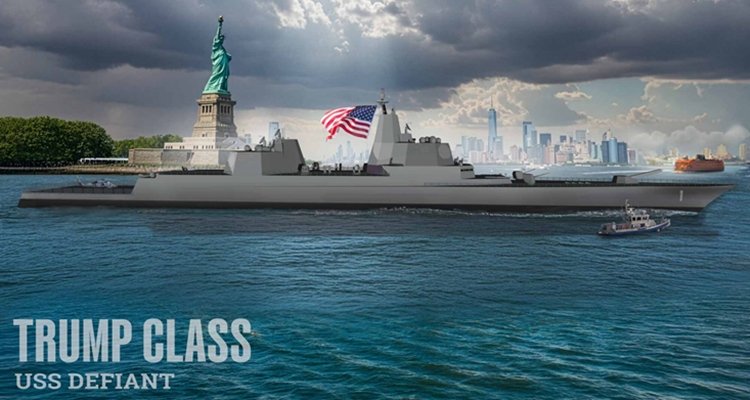
The announcement of plans to develop “Trump class” battleships really stirred up the animals, in H.L. Mencken’s memorable phrase.
Criticism started with outrage over crimes against conventions for naming U.S. Navy ships. Its classification was also challenged (It’s not really a battleship).
Some analysts presumed that the battleship was intended to engage enemies in direct fire, direct line of single combat. But this modern version would not be undertaking the missions of the old World War II battleships.
Naval power
Some of the language in the Navy’s press release may mislead the casual reader: these ships, we are told, will “outmatch any foreign adversary,” a comment seeming to suggest ship-to-ship slugfests, the great days of which have passed. The only other statement alluding to doctrine, real or inferred, is this (emphasis added):
The Trump class will be capable of operating in a traditional Integrated Air and Missile Defense role with a Carrier Strike Group or commanding its own Surface Action Group for Surface and Anti-Submarine Warfare efforts in addition to delivering long-range hypersonic strategic fires and quarterbacking the operations of an entire fleet as the central command control node.
The critics have all missed this.
The vital point is the potential to use these ships as nuclei to multiply the number of surface action groups, expanding naval power generally, what the Navy describes as a “capability to distribute more firepower across the fleet than any other class of ship….” (A surface action group is a group of ships working together. It has been defined as “a U.S. Navy task force composed of surface warships, such as cruisers and destroyers, that operates without the support of an aircraft carrier.”)
One notable feature of this press release is its omission of any mention of our “pacing adversary,” Red China. The battleship is not promoted as a specific remedy for our China challenges. And that’s okay if it serves a more general purpose that addresses all challenges, including the challenge of Beijing.
Critics aired their discontent with the hypothetical ship’s hypothetical future armaments, as depicted in a graphic describing the Golden Fleet program. These armaments include laser; railguns; anti-drone blinders; 140 launch tubesfor hypersonics; and cruise missiles, anti-ship missiles, and anti-air missiles. The graphic also shows more conventional armaments, 5-inch guns and 30-mm (anti-air) guns.
Some problems
America has major problems with hypersonics, lasers, and railguns.
Hypersonics: the Army is still testing components, the Air Force is finalizing designs, and the Navy is somewhere in between.
Railguns: “In July 2021, the service [Navy] announced it was hitting the pause button on the [railgun] program to make funding available for other weapons systems.” Railguns—electromagnetic projectile launchers—require massive energy, and their barrels melt after a few shots. Japan tested a railgun recently, but no word yet on whether its limitations have been dealt with.
Lasers: “State of Navy’s shipboard laser efforts is embarrassing, says top fleet commander.” Enough said.
But the Navy’s press release promises only that the battleship will integrate “the most advanced deep-strike weapons of today with the revolutionary systems of the years ahead.” Note: “revolutionary systems of the years ahead.” If lasers or whatnot are not ready, some other “revolutionary system” may take their place.
Commentator Bill Whittle, a former pilot, is a most enthusiastic backer of the planned Trump class battleship, seeing it (correctly) as a floating missile battery. One of his arguments is that the old battleships were superseded by aircraft carriers because carriers could deliver firepower (via aircraft) at much greater range. Now the new battleship will supersede aircraft carriers by the same measure.
Some of the other few kind words for this battleship come from National Review: “It is a relief to hear a president give more than lip service to what has become a crisis for our ability to project power and do it with ships that are built to succeed in their given roles.”
Build
And in a separate, more skeptical piece, National Review commends the impetus behind the Golden Fleet and brings Red China back into the picture.
Build as many ships as the Navy’s budget will allow—and request a larger budget next year to buy even more ships. Build frigates, build destroyers, build carriers, build logistics ships, build submarines, build amphibious warships. Build large and small surface combatants. Build both manned and unmanned vessels. Build them in America, and build them in allied countries (like Japan and South Korea) that can do it more cheaply and quickly than we can. Build ships like crazy, as the Chinese government is already doing.
That seems like a license to build a few Trump Class battleships as well.
My former colleague Hung Cao was recently sworn in as Undersecretary of the Navy. His special interest is procurement reform. Right person, right place, right time for a Golden Fleet buildup. □
James Roth works for a major defense contractor in Virginia.
Also see:
StoptheCCP.org: “U.S. and China: Our Navy, Their Navy, and the Parity of Disparity”