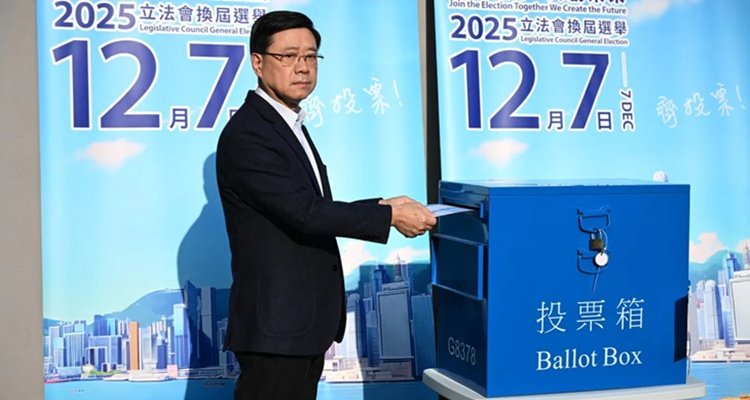
“Some foreign media have recently reported on Hong Kong ignoring the facts, spreading false information, distorting and smearing the government’s disaster relief and aftermath work, attacking and interfering with the Legislative Council election, provoking social division and opposition,” babbles a statement by the Office for Safeguarding National Security in Hong Kong.
The Office called in various foreign news agencies last Saturday for a stern talking-to on this theme (Reuters, December 7, 2025).
Saturday’s meeting comes as the authorities scramble to contain public anger over the blaze, in which poor oversight and shoddy materials used in a renovation have been cited as causes of the fire’s devastating spread.
Authorities have detained several activists who pushed for greater government accountability. Beijing has also warned people against using the disaster to “disrupt Hong Kong”.
It’s unclear what bad things will happen to news agencies if they continue to publish reports that discomfit Hong Kong officials in charge of muzzling people who ask too many questions.
Arresting critics
The Hong Kong government recently arrested a man for posting something critical about the government’s role in the Wang Fuk Court fire online. “It is the first arrest that the national security police have confirmed in relation to the Nov 26 fire, as part of what critics say is a wider crackdown on public demands for greater accountability from the government,” according to Reuters. But there has been news of other recent arrests of government critics.
Meanwhile, reports The New York Times, the Hong Kong government “was doubling down on a campaign to increase voter turnout in tightly controlled legislative elections on Sunday that are largely devoid of opposition parties, even as the city continued mourning a deadly fire that has prompted calls for official accountability.”
Hong Kong officials have been desperate to increase turnout beyond what it was in 2021, right after the patriotization of elections, i.e., elimination of all opposition candidates.
“At this critical moment of post-disaster reconstruction, we must look to the long term, steadily move ahead and gradually promote the normal functioning of society,” said the Chinese Communist Party’s man in Hong Kong, chief executive John Lee (shown above).
Lee has been leading the campaign to beg people to vote in the meaningless election. The Hong Kong government even hosted a silly citywide “Election Fun Day” “that included a gala, carnivals and open houses at government offices” to give people a warm and fuzzy feeling about casting a ballot.
Two birds with one stone
“The outreach effort may also be a way for the authorities to monitor residents in case they begin organizing opposition to the government and its handling of the fire, said Victoria Hui, an associate professor of political science at the University of Notre Dame who studies Hong Kong. ‘It seems that they are trying to kill two birds with one stone,’ Ms. Hui said.”
Emily Lau, a former lawmaker described as pro-democracy, offered this tentative conclusion: “Some Hong Kong people may feel they do not have a genuine choice of candidates.”
In the end, against all odds, the outreach accomplished the goal of increasing turnout beyond what it was in 2021: from 30.2% of registered voters back then to about 31.9% in the just-completed 2025 election, constituting a substantial further increment in turnout in the direction of a full one third of registered voters.
The Straits Times reports: “Turnout for the 2016 LegCo vote, held before the revamp [to prohibit opposition candidates], was at 58.3 per cent.”