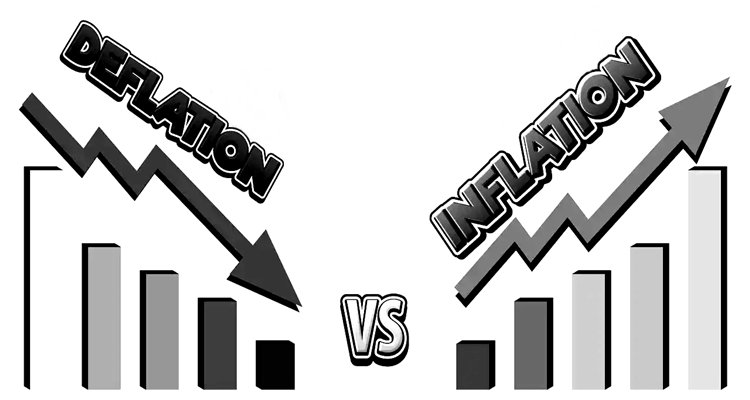
October data is in and the headlines cry out “Falling prices signal bigger troubles ahead for China’s economy” and “China’s economy is in trouble as deflation worries grow.”
Bloomberg explains, in an incomplete syllogism, that deflation “signals a lopsided economy where supply dwarfs demand. That hurts companies, which in turn hurts workers.”
“Cheaper prices can be a blessing for some,” says Politico, “but deflation is a symptom of relatively weak demand and stalling economic growth.”
And CNBC has coined a striking euphemism: “Deflation pressures in China eased in October as consumer prices returned to growth….” Sounds so wholesome. Prices are growing like a garden after spring showers or a stock portfolio after quantitative easing.
Creative destruction
We have been here before. Ten years ago, we were reading that the risk of global deflation “looms large for 2015 as surveys of China’s mammoth manufacturing sector showed excess supply and as deficient demand in January drove down prices and production.”
These imbalances actually set the stage for Joseph Schumpeter’s “creative destruction.” One economist suggests that “Over the long run, the process of creative destruction accounts for over 50 per cent of productivity growth.” If he’s right, then consumers get a lower cost of living and the economy expands as capital is reallocated.
It makes no sense to demonize deflation and promote inflation. Investment manager Peter Schiff has been decrying this tendency for a long time. Back in 2014, he argued:
In order to justify our current monetary and fiscal policies, in which governments refuse to reign in runaway deficits while central banks furiously expand the money supply, economists must convince us that inflation, which results in rising prices, is vital for economic growth.
Simultaneously they make the case that falling prices are bad…. But lower prices function as a counterweight to a contracting economy by cushioning the blow of the downturn.
A kind of legend among modern economists holds that during price decreases, consumers and businesses wait to spend and invest since they expect prices to keep falling. The assumption is that consumers have a low time preference that stretches across all needs and products. Quite an assumption. “Discounts often motivate consumers to buy,” observes Schiff, inviting us to “try the experiment yourself the next time you walk past the sale rack.”
Deflation = threat?
Journalists, who tap prominent economists for their expertise, thoughtlessly promote the notion that deflation = threat to economy. A little history could help them a great deal. For example: “According to the Department of Commerce’s Statistical Abstract of the United States, the ‘General Price Index’ declined by 19% from 1801 to 1900. This stands in contrast to the 2,280% increase of the CPI between 1913 and 2013.”
Economists like inflation as much as they dislike deflation. On the Investopedia website, we read that “Moderate inflation can stimulate spending and economic activity by encouraging consumption and preventing deflation.”
Where does this pro-inflation thinking come from? In part from John Maynard Keynes, whose famed General Theory (1936), still a dominant force in economics, is critiqued on such grounds. But many of his writings tell a more mixed tale.
In a 1923 essay, he put a pox on both houses, declaring that “Inflation is unjust and Deflation is inexpedient. Of the two perhaps Deflation is, if we rule out exaggerated inflations such as that of Germany, the worse; because it is worse, in an impoverished world, to provoke unemployment than to disappoint the rentier. But it is not necessary that we should weigh one evil against the other. It is easier to agree that both are evils to be shunned.” Keynes attributed inflation to government overspending and the political strength of the creditor class.
His comment on the creditor class takes us to Marx and the view of some modern Marxists in the UK that the question of inflation and deflation “is not just as a technical issue of monetary policy but…a site of class conflict.” This should be of special interest to Chinese communists: “Workers struggle to maintain their living standards in the face of rising prices, while corporations attempt to protect their profit margins. This perspective highlights the power dynamics at play and the potential for social and economic unrest.”
Our good friends at WorldSocialism.org are more concise. “Inflation is depreciation of the currency.” Let’s buy the CCP a subscription.
In his 1919 book The Economic Consequences of the Peace, Keynes put Lenin on the record with an insight that Beijing should try to relearn:
Lenin is said to have declared that the best way to destroy the Capitalist System was to debauch the currency. By a continuing process of inflation, governments can confiscate, secretly and unobserved, an important part of the wealth of their citizens….
Lenin was certainly right. There is no subtler, no surer means of overturning the existing basis of society than to debauch the currency. The process engages all the hidden forces of economic law on the side of destruction, and does it in a manner which not one man in a million is able to diagnose.
Lenin’s insight goes beyond any “Capitalist System.” Beijing’s money printing and ensuing malinvestment are threatening to destroy its own style of communism and the livelihood of its subjects. Deflation, however, if allowed to run free, could correct course. Fortunately or not, modern economists will guide the regime back to inflating its way into ever bigger trouble.
Postscript
Unfortunately, Milton Friedman seems to be one source of the black legend against deflation.
A steady rate of monetary growth at a moderate level can provide a framework under which a country can have little inflation and much growth. It will not produce perfect stability; it will not produce heaven on earth; but it can make an important contribution to a stable economic society.
Considering all of Friedman’s good work, it’s a shame that mainstream economists have pledged allegiance to one of his most dubious assertions. □
James Roth works for a major defense contractor in Virginia.
Also see:
StoptheCCP.org: “Is China’s Stock Market Even Worse Than a Casino?”
StoptheCCP.org: “China’s Bold Stimulus Package Backs Losers, Reinforces Failure, Extends Losses”