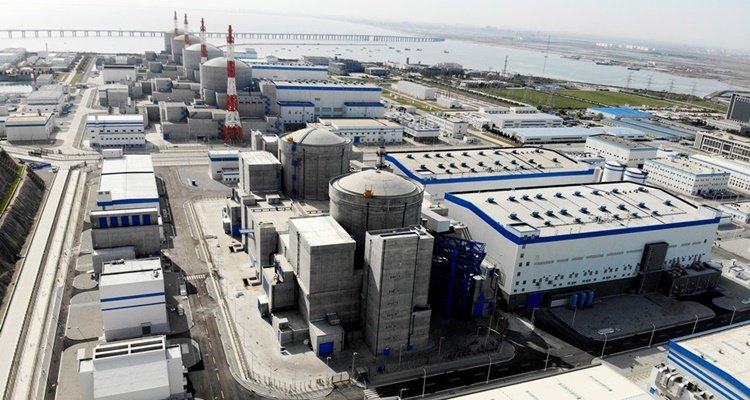
Mark Hibbs, author of The Future of Nuclear Power in China, projects that China’s nuclear capacity will exceed that of the United States by 2030. “The Chinese are moving very, very fast. They are very keen to show the world that their program is unstoppable.”
According to The New York Times, China has “conquered” the financially and physically difficult job of building nuclear reactors, “one of the most complex construction projects on Earth,” enabling it to become a global leader in nuclear power (“How China Raced Ahead of the U.S. on Nuclear Power,” October 22, 2025).
It starts with heavy government support. Three state-owned nuclear developers receive cheap government-backed loans to build new reactors, which is valuable since financing can be one-third of costs. The Chinese government also requires electric grid operators to buy some of the power from nuclear plants at favorable rates.
Just as importantly, China’s nuclear companies build only a handful of reactor types and they do it over and over again….
The fact that the Chinese government has a national mandate to expand nuclear power means that companies can confidently invest in domestic factories and a dedicated engineering work force. In a sprawling complex near Shanghai, giant reactor pressure vessels are being continuously forged, ready to be shipped to new projects without delay. Teams of specialized welders move seamlessly from one construction site to the next.
It’s been different in the West.
In the 1970s and 1980s, U.S. nuclear construction slowed to a trickle as interest rates rose and regulators frequently tightened safety rules, causing delays. Worries about the disposal of nuclear waste and fears after the 1979 partial meltdown of a reactor at Three Mile Island, in Pennsylvania, didn’t help. At the same time, private developers kept experimenting with new reactor designs that required different components and introduced fresh complications. U.S. nuclear power died from a lack of predictability….
Nuclear proponents in the United States sometimes argue that overly strict safety regulations drive up costs.
China’s safety requirements are similar. But in China the approval process is more predictable, and opponents have fewer ways to challenge a project.
Despite the obstacles, the Trump administration “wants to quadruple U.S. nuclear power by 2050, even as it ignores global warming, and it hopes to develop a new generation of reactor technology to power data centers at home and sell to energy-hungry countries overseas.”
The tendentious aside about ignoring global warming is an allusion to the fact that many people prefer nuclear power because nuclear reactors don’t emit the dread carbon dioxide, as if there were little reason but subscription to environmentalist theology to favor this method of reliably producing electricity. Of course, mining and transport of uranium, building the nuclear facility, disposal of nuclear waste, and other processes involved in constructing and operating nuclear reactors do generate carbon emissions.
The Times writers also seem dismayed by the fact that the U.S. “is pursuing a starkly different path to nuclear expansion, one that leans more heavily on private innovation than government backing.” I feel that this is a survivable difference.
Also see:
StoptheCCP.org: The Thorium Reactor Syndrome