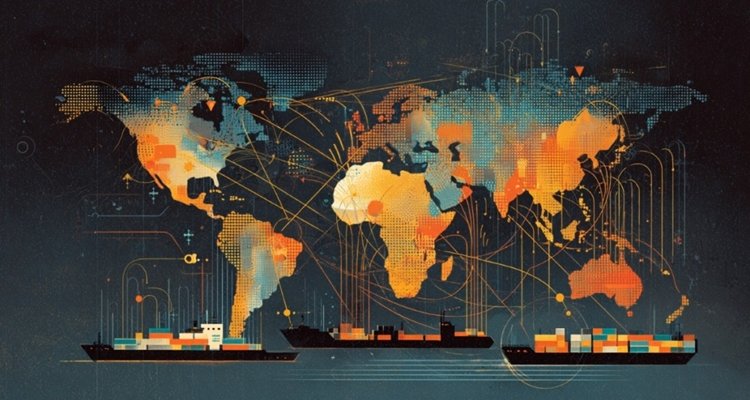
War on the Rocks argues that the United States government has not been paying enough attention to supply chains. In February 2025, the Senate Commerce Committee warned that “one chain shock can disrupt the entire system, driving shortages and raising costs.” WOTR author Jesse Humpal uses a 2017 calamity to illustrate the problem (October 10, 2025).
Acting on the committee’s warning, in June 2025 the U.S. Senate unanimously passed the Promoting Resilient Supply Chains Act. The legislation would require a sub-department of the Department of Commerce to “monitor and respond to disruptions in critical industries and supply chains” by working to identify vulnerabilities in the supply chains of critical industries and fix problems in cooperation “with other governmental bodies and key international partners.”
However, the U.S. House has yet to act on the legislation.
What happened in 2017?
In 2017, the world’s largest shipping company, Maersk, went dark. A state-sponsored cyber attack known as NotPetya spread from Ukraine into global networks, paralyzing terminals from Los Angeles to New Jersey. Cargo piled up, factories waited on missing parts, and workers resorted to moving containers with Post-it notes and WhatsApp messages. The White House later attributed the attack to Russia’s military intelligence agency, calling it “the most destructive and costly cyber attack in history.” The disruption cost Maersk hundreds of millions of dollars and showed how a single supply chain shock can ripple across economies. Yet nearly a decade later, the United States still treats supply chains as a subset of other sectors rather than the critical infrastructure they plainly are….
When faced with crises, the United States has relied on familiar but limited tools….
The Defense Production Act has been invoked for ventilators, baby formula, and semiconductors. Yet it remains a surge mechanism, useful only after disruptions occur, not before….
Presidents have also tried to fill the gaps through executive orders….
Humpal says that battles over jurisdiction help explain delays in taking appropriate action. “Agencies that already manage supply chains want to hold onto that authority…. Jurisdictional battles are easier to tolerate if supply chains are seen as economic. They are harder to justify if supply chains are understood as matters of national security.”
Like a light switch
I don’t know whether the proposed legislation would improve matters. But it is incontrovertible that “America’s rivals already view supply chains as battlefields.”
In August 28 of this year, War on the Rocks contributors declared: “The Pentagon’s arsenal and defense industrial base is built on materials that China can turn off like a light switch.”
The writers were talking about critical minerals and magnets, etc., which are especially in the news lately because the People’s Republic of China is tightening its export controls so severely that President Trump felt obliged to threaten a return to U.S. tariffs on imports of Chinese goods in excess of 100 percent. Trump has also been pushing for more mining of the critical minerals—for example, in Alaska—with respect to which we have become so dangerously dependent on China.
Humpal observes the risk of expanding or rejiggering government oversight of supply chains as envisioned by the stalled legislation. “Government involvement in private supply chain relationships can improve security, but also risks distorting markets. Even federal agencies struggle to enforce their own supply chain rules, which raises doubts about how far such oversight can extend into the broader economy.”
But: “Vulnerabilities in commercial systems, such as rare earth processing, also endanger military readiness. A dedicated sector would bridge that gap.” Supply-chain resilience must become “a standing priority rather than a scramble after the fact.”