We may speculate about the outcome of the Fourth Plenary Session of the Chinese Communist Party, being held October 20 to October 23; but financial analyst James Rickards says that the biggest development has already happened.
Toward the end of September, he wrote that “the Chinese political system has undergone a military coup d’état. President Xi Jinping has been demoted to a position subordinate to a new committee headed by the top leader of the People’s Liberation Army. Cliques loyal to former presidents Hu Jintao and Jiang Zemin have emerged from hiding and are now becoming politically active again.”
Hu, Jiang, Wen
Hu Jintao was chairman of the CCP until 2012, and was also president of the state. Jiang Zemen was the previous chairman and president. We may as well add Wen Jiabao, former prime minister, and his followers. They were not hiding, they were simply out of the spotlight. These are likely the “elders” referred to in current speculation.
Rickards does not give details of the coup. Was this a civilian or a military demotion? Xi holds four positions (sometimes counted as three): president, party chairman, and chairman of the bifurcated Central Military Commission. The last consists of the Central Military Commission of the Communist Party and the Central Military Commission of the People’s Republic, often counted as the same thing.
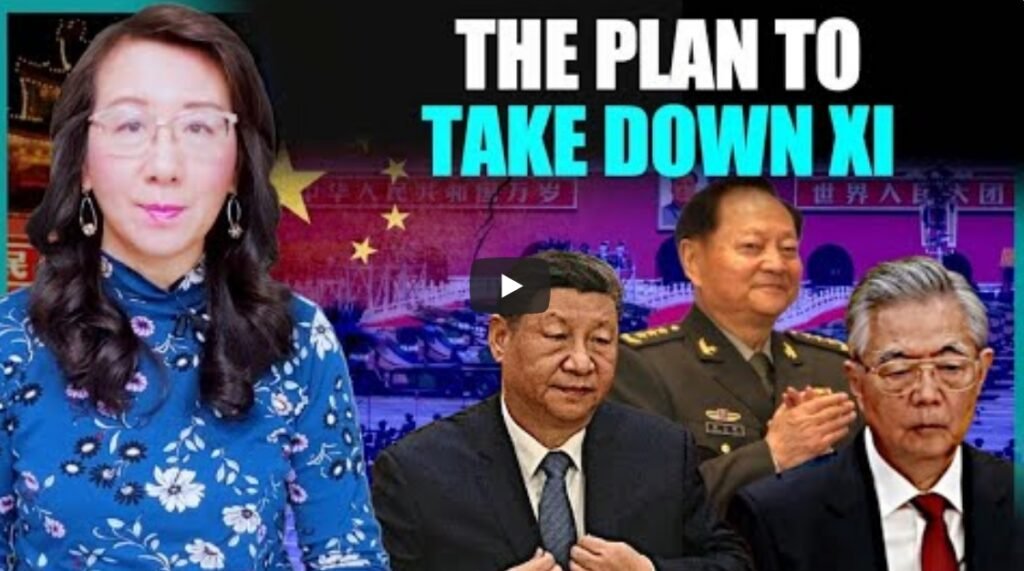
As far back as February 2025, the China Leadership Monitor asked, “Can Xi Control the PLA?” In May, People News reported that according to some observers, “Military Commission Vice Chairman Zhang Youxia is orchestrating the purge of Xi’s influence with the backing of CCP elders.” In late June, Gregory Slayton, writing for the New York Post, said that “never have we seen the recent purges (and mysterious deaths) of dozens of People’s Liberation Army generals loyal to Xi; all replaced by non-Xi loyalists. Zhang Youxia, with whom Xi had a major falling out after [he had helped] Xi secure an unprecedented third five-year term, is now the de facto leader of the PLA.”
Perhaps Zhang’s ascendance in the Military Commissions is the coup Rickards mentions. If Zhang is de facto in charge, does he control the Beijing military garrison?
Showdown
Analyst Lei of Lei’s Real Talk speculates that if Xi loses two of his posts, his faction will collapse. But if he has lost one already, becoming a figurehead in the Military Commissions, that leaves the big one, Party chairman, and a little one, chief of state. The situation seems perilous enough that rumors have him planning his exile, possibly in North Korea.
Lei expects a showdown between Xi and the “elders” at this month’s plenum rather than at the Party congress in two years. She spins four scenarios: Xi resigns everything at the plenum; he gives up just one of his posts (assuming he still heads the Military Commissions); anti-Xi forces whip up enough support to vote him out and strip him of his offices; Xi defies the opposition and hangs on until the next Party Conference in two years.
“What if those expected to denounce Xi lose their nerve and stay silent?” Lei asks. “The only way for the anti-Xi camp to be absolutely sure of removing Xi is to physically control him and his inner circle the moment he refuses to cooperate. That way, they can release a statement in his name and skip the risky Central Committee vote altogether.”
Interesting that the New York Post reported that Xi’s protective detail had been halved. How could that have been his own decision?
The Central Committee members owe their position to Xi and would be a tough roadblock to bypass. But members can read the signs, which also include the “un-naming” of the mausoleum of Xi’s father, built to be larger than Mao’s or Deng’s.
Four norms
The forcible removal of Xi would violate one of the four norms introduced by Deng Xiaoping most relevant to introducing “a measure of predictability into the vicissitudes of Chinese elite politics.” But according to Brooking’s Jonathan Czin, Xi has already broken all four himself. The norms are:
Establishing a regular, if flexible, political calendar for the Party leadership;
Implementation of retirement norms;
Beginning to establish norms for succession;
Adopting a tacit “gentleman’s agreement” not to go after top officials…for corruption.
All this does not point to anything like a consensus about Xi’s future. For example, Michael Cunningham of Australia’s Lowy Institute seems adamant that Xi is safe.
Despite the noise, no one has credibly explained how a leader who dominates every significant CCP organisation could be toppled. All seven members of the Politburo Standing Committee are either long-time Xi allies or have served him loyally for over a decade. More than half of the broader Politburo’s 24 members are his protégés, and nearly all the others had direct ties to him prior to their appointments. The factions rumoured to be plotting against Xi lack meaningful representation in the bodies that appoint and remove senior officials. The notion that these sidelined groups have somehow outmanoeuvred a political operator as shrewd and relentless as Xi strains credulity.
This assumes that Xi’s power base is intact and that he will fight. If we can wait until October 20 to 23, we’ll all find out about credulity and credibility. □
James Roth works for a major defense contractor in Virginia.
Editor’s note: According to as yet unconfirmed reports that Lei of Lei’s Real Talk finds initially plausible, Xi Jinping has just suffered a stroke. We received the tidings after Mr. Roth had submitted this column. If true, the affliction may make it almost impossible for Xi to continue in his posts no matter what his current status and no matter what moves and counter-moves have been planned for the Fourth Plenary Session. Lei herself suggests that if the report is false, it may be a ploy that originated from Xi’s own camp. In western media, many recent stories about the plenum seem to be ignoring the reports of a stroke. I guess we’ll know something more for sure soon enough.