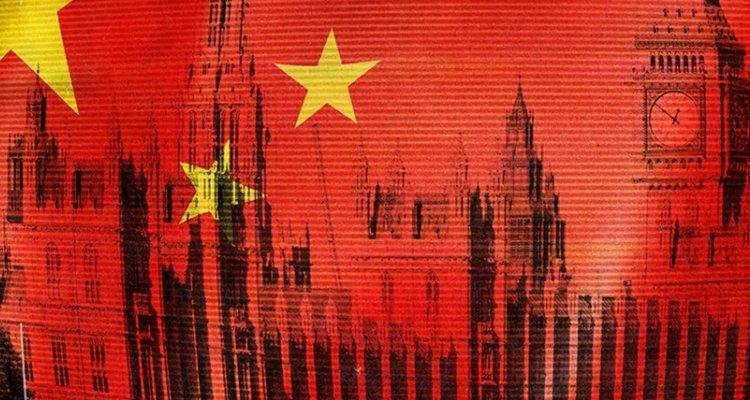
A couple of weeks ago, we relayed the news that UK prosecutors had dropped charges against Christopher Cash and Christopher Berry of spying on Parliament for the People’s Republic of China.
The news reports weren’t conclusive in mid-September about why the charges were dropped (and still are not conclusive despite the evidence piling up). But The Times (UK) did observe at that time that “the government has been accused of softening its approach to Beijing in the hope of improving economic relations.” (It would have been been a bridge too far, presumably, for The Times to have here reported as fact, not merely as the contention of others, that the current UK government “has often softened its approach to Beijing in the hope of improving economic relations.”)
Official secrets
Back then, opposition lawmakers expressed outrage about the dropping of charges and suspected the worst of the Labour government. Meanwhile, Prime Minister Keir Starmer and Home Secretary Shabana Mahmood “expressed disappointment about the decision” to drop the charges. The implication was that they themselves had had nothing to do with getting the charges dropped. How could they, when, as they said, they were disappointed that the charges had been dropped? Unless…well, unless they were lying.
In its September 19, 2025 report, The Times said that Berry and Cash “were charged last April under the Official Secrets Act with passing information to an ‘enemy’. As recently as last week police were preparing witnesses before a trial next month….
“Stephen Parkinson, the director of public prosecutions, linked the decision to drop charges to the requirement under the Official Secrets Act of 1911 that information is passed to an ‘enemy’, raising the question of whether national security witnesses, who were expected to give evidence to support the claims, had backtracked.”
Backtracked about what?
It seems that the witnesses may have “backtracked” about whether the People’s Republic is an enemy of the United Kingdom.
Monkton points us to a recent LinkedIn post published by Human Rights in China.
Two British nationals—Chris Cash and Christopher Berry—were accused of leaking confidential parliamentary information to Beijing, reportedly reaching Cai Qi, one of Xi Jinping’s closest allies and the fifth-ranking member of the CCP Politburo. Despite what investigators described as “slam-dunk” evidence of espionage, government witnesses were instructed to describe China only as a “challenge,” not an “enemy”—a change that made prosecution under Britain’s Official Secrets Act impossible. Officials involved say the order came “from the very top.”
The result is the worst breach of parliamentary security in living memory—and a precedent which effectively shields future Chinese espionage from prosecution. The timing, as London seeks to rekindle trade talks with Beijing, has fueled accusations of political interference and appeasement. By softening its stance in pursuit of perceived economic benefit, the government has signaled to authoritarian powers that strategic interests can outweigh justice and national security….
When democracies censor their own language to placate a regime responsible for mass internment, censorship, and transnational repression, they corrode both moral authority and credibility. This was not just a legal collapse—it was a moral one….
The wording of this LinkedIn post is inaccurate on one point. The “worst breach of parliamentary security in living memory” happened long before the charges were dismissed—so could not have been the result of official recharacterization of the PRC or of dropping the charges. Perhaps the intention was to say something like “The result is a failure to prosecute the worst breach of parliamentary security in living memory….”
The challenge of the enemy
In any case, it seems clear that top-level instructing of lower-level functionaries to instruct government witnesses to regard China as a “challenge” and not an “enemy”—and not some sudden vindication of the defendants—is what somehow brought the case crashing down. The Official Secrets Act, The Times reported on October 5, “specifically requires prosecutors to show a defendant acted for an enemy”; but the Labour government’s National Security Strategy 2025 “stops well short of referring to China as an ‘enemy’ state, characterising it as a ‘challenge’ instead.”
But this is insane. It would be like dismissing a murder charge solely because a witness to the murder suddenly misunderstood what constitutes a murder while still remembering the knife going in and out, the face of the killer, location and time, etc. So the sudden replacing of the word “enemy” with the word “challenge” by a witness or witnesses, if this is what happened, cannot be the whole story.
If the government had wanted to present evidence in court that the People’s Republic of China and the Chinese Communist Party are indeed an enemy, the witnesses’ voluntary or coerced confusion on this point would not have prevented the government from doing so. The corrupting of the witnesses’ grasp of geopolitics, of the history of Red China, and/or of the ordinary meaning of words must have been combined with an implicit or explicit order to dismiss the case. The evidence of the conduct of the defendants would remain the same no matter what the witnesses believe about the nature of the People’s Republic of China or what constitutes an “enemy.”
If the prosecutors, who had stuck with the case for months and thought it was slam-dunk, did not act on their own in dropping the case, then the order to dismiss must have come from somebody with the power to give the order. Somebody who was waving around a copy of the National Security Strategy 2025.
The Starmer administration insists that it had nothing to do with the scuttling of the case. Well, this is not quite what it insists.
According to a BBC report from October 6, “Number 10’s press secretary said ‘the suggestion that the government withheld evidence, withdrew witnesses or restricted the ability of a witness to draw on a particular bit of evidence are all untrue’. It comes after the Sunday Times reported senior Whitehall officials met to discuss the trial early last month before the charges were dropped.”
Note the wording. On one interpretation, Starmer could still have ordered that prosecutors drop the case even if the press secretary’s denials are literally true. The charges are not that the government “withheld evidence” or “withdrew witnesses” or somehow stopped a witness from referring to evidence of the spying (as opposed to evidence of whether the People’s Republic of China is an enemy of the United Kingdom). The charges are witness tampering and word tampering and giving an implicit or explicit order to dismiss the case.
Of course, doing these things could also be construed as a form of withholding evidence. Without a trial, no evidence can be presented in court.
From the top
According to the October 5, 2025 report by The Times (UK), orders to in effect drop the case came from “the very top.”
Early last month [September], [Jonathan] Powell, the national security adviser, convened a top secret meeting of mandarins from across the government. He used the gathering to discuss the potential diplomatic and security consequences of the trial, but also raised the evidence that Collins, the government’s key witness, was due to put forward. [Matthew Collins was “the deputy national security adviser due to give evidence for the prosecution…”]
According to Whitehall sources, Powell said that Collins would draw upon National Security Strategy 2025, which was published in June. It refers to China as a “geostrategic challenge” whose actions have “the potential to have a significant effect on the lives of British people”. It does not describe the People’s Republic as an enemy.
Instead, it says the government seeks a “trade and investment relationship” with China, coupled with a “threat-driven” approach to issues such as espionage, interference in democracy and economic security. Robbins was also present and used the meeting to raise concerns about the implications of any conviction….
Powell is one of Sir Keir Starmer’s closest advisers and a direct political appointment. It is not clear who made the decision to limit what Collins could say. However, witnesses were told by investigating police officers that it came from the “the very top”….
[Tory MP Alicia Kearns] said: “The collapse of the trial is inexplicable without ministerial or NSA [national security adviser] involvement.”
Human Rights in China is right. We have here a precedent which, if hewed to, “effectively shields future Chinese espionage from prosecution”; which tells thug-governments “that strategic interests can outweigh justice and national security”; which is “not just a legal collapse” but a moral collapse.