Somewhere in all the FPRI’s metaphors about strategic compression, strategic friction, stasis, etc. is the suggestion that the People’s Republic of China is getting closer and closer to doing something really stupid and dangerous, like try to annex Taiwan, which a 2025 white paper issued by the PRC casts “not as an ambition but as a requirement for survival” (“China’s Closing Window: Strategic Compression and the Risk of Crisis,” Foreign Policy Research Institute, October 2, 2025).
The danger of “this moment”—which “Washington must recognize”—is that to get out from under all its problems, China will allow its “decision space” to shrink and its “timeline for action” to accelerate. “Forces” are producing a “closing window” in which “Beijing perceives a diminishing opportunity to achieve its central project: the ‘national rejuvenation’ with the main marker of absorbing Taiwan.”
Compression and regression
I think—correct me if I’m wrong—that the author is saying that the CCP regards the grabbing of Taiwan as a means, perhaps the only means, of preventing the People’s Republic from sinking into the quicksand and that the Party or Xi believes that China is running out of time to do this.
Incidentally, “Compression is both structural and perceptual, but the latter is the primary force. Leaders act not on perfect information but on how they read the trajectory of time.” Beijing’s perception of the trajectory of time is that “delay is fatal.”
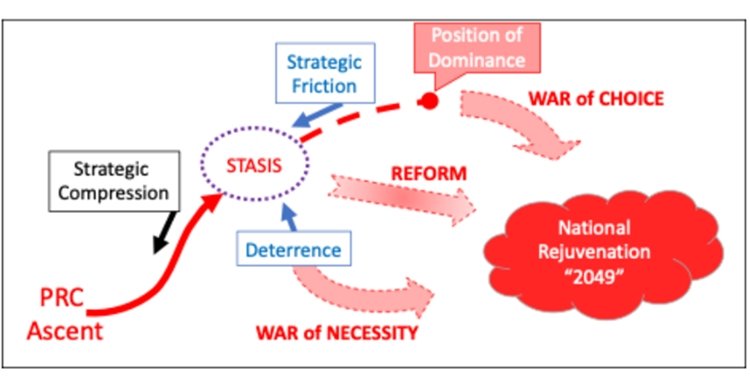
Alternatively, the PRC could institute internal steps to reverse its self-destruction. But reform doesn’t seem to be in the cards. Whether the government seeks reform or crisis as the way out, though, “time itself has become China’s adversary.” The author recognizes the significance of the passage of time.
“Authoritarian systems compensate for stagnation with propaganda. Xi Jinping has tightened control over media, education, and party messaging to frame China as besieged by hostile forces determined to block its rightful rise. The 2025 National Security White Paper codifies this framing, subordinating economic goals to regime security and elevating Taiwan’s annexation as a matter of existential survival.
“This narrative thrives in crisis conditions. The CCP has demonstrated repeatedly that crises, whether real or manufactured, strengthen its grip.”
The point is mostly valid but the author’s characterization is not quite accurate. Crises don’t act to strengthen the grip of any government or party. The power holders who exploit the crises are doing the grip-strengthening, using crisis as cover and rationale.
“The CCP today faces a paradox. It possesses the world’s largest navy, expanding nuclear forces, and formidable coercive tools in the gray zone. Yet its foundations, population, economy, and governance are eroding. This creates a system both powerful and brittle: strong enough to coerce neighbors, weak enough to fear internal unraveling. In such a system, strategic compression does not just narrow options; it warps incentives. It encourages Beijing to equate inaction with defeat and to view the crisis not as a danger to avoid but as a tool to embrace.”
So what should other countries, like the U.S., do in recognition of this “dangerous crossroads”?
Action and reaction
We should make an attack on Taiwan “or coercive escalation elsewhere…prohibitively costly and uncertain of success.” We must be “raising costs, slowing progress, and diverting resources,” these being ways of fostering “strategic friction.”
Examples: “Blocking acquisitions of semiconductor assets through Committee on Foreign Investment in the United States reviews, restricting technology transfer in artificial intelligence and quantum computing, and enforcing intellectual property protections complicate the PLA’s modernization path. Securing supply chains for rare earths, lithium, and other critical minerals prevents Beijing from leveraging global chokepoints for both military and economic coercion.”
Also, counteract CCP propaganda. “Public diplomacy should contrast China’s rhetoric of defense with its record of expansion, elite capture, and debt-trap diplomacy. Indo-Pacific partners can be empowered through digital literacy campaigns and intelligence sharing to resist Chinese disinformation and build societal resilience.”
But following through on these familiar suggestions is not enough. We also need a “release valve” that will enable the CCP leaders to “deal with the frustrated energy.” This valve may take the forms of “emphasiz[ing] mutual restraint, regional arms control dialogues, or a face-saving role in global initiatives (climate, disaster response, infrastructure) that sustain legitimacy without confrontation.”
Will giving the CCP a “role” in climate jabberwocky and the rest of it really “offer a win-win alternative that preserves peace without rewarding coercion”? Is there any chance that the CCP will accept such consolation prizes and relinquish all its motives and agenda to date? Also, is there any danger in treating CCP officials as if they are as dumb as they treat everybody else?
Friction and stasis
Perhaps the metaphors will save us. “In the physics of compression, movement itself becomes the danger. Strategic friction must keep the CCP floating; denied the purchase to hurl itself through the closing window, yet held aloft from collapse. Perhaps this enforced stasis can prevent catastrophe.” (FPRI has a graph, shown above, to summarize all this physics.)
But I don’t think that we—or friction or valves or stasis, any of our figure-of-speech comrades in the effort to slow down the People’s Republic of China—should accept the job not only of deterring the PRC from stomping Taiwan et al. but also of holding the PRC “aloft from collapse.”
I don’t want the totalitarian dictatorship to continue. Do you? I don’t want to help it to oppress and murder people. Do you? If we don’t, enabling this vicious regime to go on and on and on, aloft, in stasis, whatever, should not be a goal of the semi-free world’s foreign policy as it has been at least since Nixon and Carter. If this isn’t what the author means to suggest, some clarification is in order.