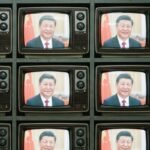
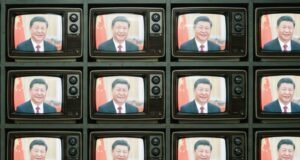
Beijing staged a big parade this week and to go with it made some big revisions to the history of World War II.
“Chinese leader Xi Jinping has directed an expansive propaganda campaign in recent months to trumpet the party’s account of how it helped defeat Japan,” The Wall Street Journal reports (September 1, 2025). “Party scholars and curators produced essays and exhibitions portraying the Communists as a foundation of Chinese war efforts against Japan—diluting the credit traditionally given to Chiang Kai-shek’s Nationalist Party, which governed mainland China until 1949.”
“Diluting” is an understatement. Let’s start at the ending.
Surrender
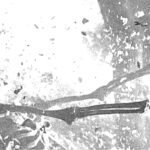
“On Sept. 9, 1945, a week after agreeing to the terms laid out by the Allied forces, Japan, at a ceremony in Nanjing, formally surrendered to China’s National Revolutionary Army–the military wing of the nationalist Kuomintang led by Chiang Kai-shek” (shown above).
On October 10, 47 Japanese divisions surrendered to Nationalist officers for disarming and repatriation.
The peace treaty took longer. It was signed on April 28, 1952 in Taipei between Japan and the Republic of China—not between Japan and the People’s Republic of China. The communists were impotent bystanders in the making of the peace.
Article II states that Japan “has renounced all right, title and claim to Taiwan (Formosa).” Thus, the sovereignty of this Japanese colony was surrendered to Taipei, not to Beijing.
Setting aside end-of-war legalities and formalities, let’s look at the combat record. It’s clear that the communists were a stumbling block in the defeat of Japan.
Saved by the war
The eruption of war with Japan saved the rebel communists from losing their struggle against the Chinese government. Zhang Guotao, a Red Army officer, recalled that “on 7 July 1937, Mao Zedong and his supporters were pleased, saying that ‘this would weaken the KMT forces.’” In 1945, Mao noted approvingly that “the Japanese invasion south of the Great Wall in 1937…forced [the government] to abandon its nation-wide civil war for a time.”
Result: Throughout the war, the CCP “engaged in small skirmishes and largely took the time to recruit party members.”
When the communists entered into a united front with the KMT from 1942 to 1945, they used the time not to join the fight against Japan but to launch three years of brutal Stalinist purges against fellow communists, purges that, incidentally, did not spare Moscow-trained Chinese. Many of the features of the future Cultural Revolution were present in this “Yenan Rectification Movement.”
For instance, it
was characterized by brutal purges that targeted intellectuals, party members, and military officials suspected of ideological deviance. Mao implemented intense self-criticism sessions, forced confessions, and psychological torture, creating an atmosphere of fear and paranoia.
Mao’s methods were systematic and deliberate. He promoted mass interrogations, where individuals were pressured to denounce their comrades. These confessions were often extracted through prolonged psychological stress, starvation, and public humiliation.
Those accused of opposing Mao’s ideology were forced to endure ‘struggle sessions,’ during which they were beaten, ridiculed, and made to publicly confess fabricated crimes against the party.
Not so many Japanese soldiers killed. But the Reds did succeed in killing 10,000 of their own.
Homare Endo, “born in China in 1941, experienced the Chinese Revolutionary War before relocating to Japan in 1953,” according to an author bio, and she has compiled a brief wartime resume for the leader of the CCP.
During the Sino-Japanese War, Mao Zedong concentrated his efforts on conspiring with the Japanese army to weaken the KMT forces. He planted Communist spies such as Pan Hannian in the Japanese Foreign Ministry’s local agency Maison Iwai and sold KMT military intelligence obtained from the National Government in Chongqing through the KMT-CPC Cooperation to the Japanese at a high price, creating an environment in which it was easy for the Japanese military to deal blows to the KMT forces.
And that is not all.
Mao Zedong sent Communist spies to make direct contact with the Japanese army, even going as far as to propose a truce between the CPC [CCP] forces and the Japanese army….
When Mao Zedong met former members of the Imperial Japanese Army or leftwing Japanese, he said over and over again in many different ways that he was grateful to the Imperial Japanese Army.
She provides more details here.
Priorities
Homare Endo also quotes from a report written by the staff section of the Japanese North China Area Army in October 1, 1940: “The mission of the CPC forces for the time being is to make Japan and the Chongqing Government fight each other as long as possible and build up their own strength in the meantime…. They are moving to prevent Japan engaging in peace talks with the Chongqing Government. Because unless the Japanese Army and the Chongqing Government keep on fighting as long as possible, the CPC forces will not have the time they need to grow stronger.”
U.S. General Alfred Wedemeyer, who replaced General Joseph Stilwell as chief of staff to Chiang Kai-shek, on some level knew of this, judging by his words: “Although the Japanese offered increasingly favorable surrender terms during the course of the war, China elected to remain steadfast with her Allies. If [Republican] China had accepted surrender terms, approximately a million Japanese would have been released for employment against American forces in the Pacific.”
That seems to be an unmatchable contribution to the Allied cause. Parades and propaganda should not obscure it. □
James Roth works for a major defense contractor in Virginia.