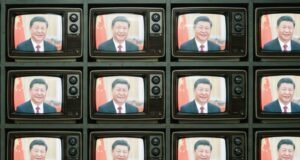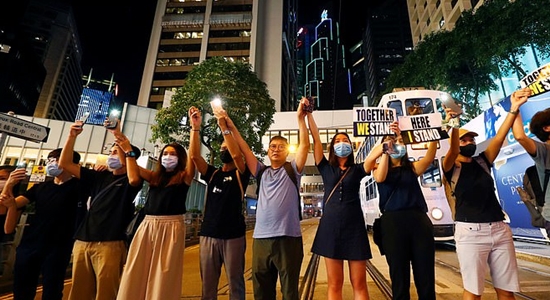
The Chinese Communist Party likes to tighten its nooses, and it is again tightening its noose around Hong Kong (“Hong Kong Rushes to Beef Up Security Law, Cementing China’s Grip,” Bloomberg, May 15, 2025).
Hong Kong fast-tracked new national security rules that further consolidate Beijing’s control over the financial hub, with the changes taking effect immediately.
The government on Tuesday gazetted [announced] measures to facilitate the work of Beijing’s national security office in the city, including new penalties for failing to comply with investigations. Premises used by the body—known as the Office for Safeguarding National Security—will be designated “prohibited places,” according to an official statement….
The rules include provisions requiring public servants to assist the OSNS and granting immunity from civil liability to anyone who complies with the office’s orders….
Beijing is effectively carving up “ ‘extra-territorial’ pockets for China’s criminal system within Hong Kong,” according to Victoria Hui, a political science professor at the University of Notre Dame. Hong Kong maintains a separate and independent judicial system from mainland China….
The government marked six sites [set aside for the work of OSNS] as prohibited areas…. Entering such places without a permit is punishable by up to two years in prison and a fine.
Hongkongers who disobey an order of the Office for Safeguarding National Security or who reveal the existence of an OSNS investigation can be imprisoned for up to seven years.
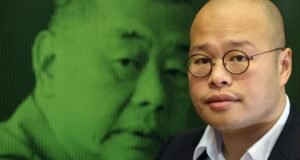
The report suggests that China’s harassment of Hong Kong billionaire Li Ka-shing—motivated by the willingness of his company CK Hutchison Holdings to sell port assets around the globe, including those near the Panama Canal, to a consortium led by a U.S. company—is causing other wealthy investors to “reassess their exposure to the former British colony.”
It seems that every time the Chinese Communist Party acts like the Chinese Communist Party, a few more people who have been pretending otherwise reassess. But nobody needs to wait to be clubbed over the head by facts that are readily available right now. Let everybody who has been evading the nature of the Chinese party-state reassess immediately.
So-called repression
Some reporters should also reassess. For example, the author of the above-quoted Bloomberg article about China’s intensifying tyrannical control of Hong Kong—its “grip”—should reassess.
In the article, reporter Alan Wong adopts the frequent journalistic strategy or tic of avoiding unbuffered reference to China’s tyranny in such a way as to indicate straightforward acceptance of this fact. Such reporters are often comfortable saying only that some people believe that the Chinese government is repressive. Thus, Wong notes that one of his sources, Victoria Hui, “said allowing Beijing to handle national security cases in the city helps minimize potential backlash to what she called repression.”
Wong in this sentence establishes indirect discourse, that he is giving Hui’s view. Nevertheless, he is loath to simply paraphrase what she said. He feels obliged to haul us out of the paraphrase in order to remind us that Victoria Hui’s view that China is repressing Hong Kong really is her view: it’s “what she called repression” (emphasis added). The reporter is not gonna commit himself to this assumption.
For all Wong knows, China isn’t repressing Hongkongers at all. He’s just the reporter here! And reporters don’t report facts, they report only what other people call facts. Of course, such a philosophy of reporting can’t be followed with anything like consistency—and it isn’t.