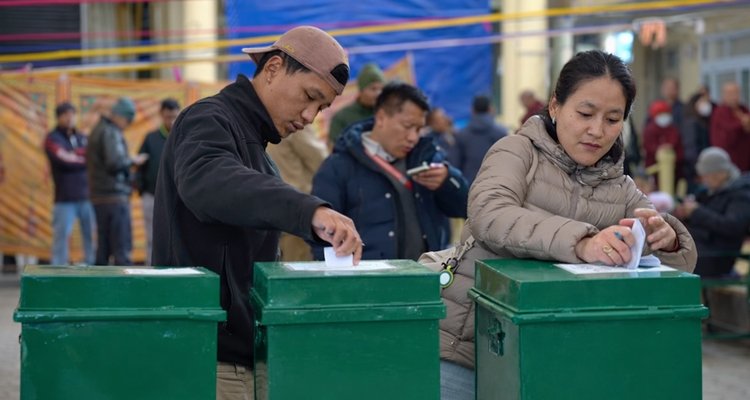
Expatriate Tibetans have been participating in a multi-country election of the Central Tibetan Administration, the Tibetan government in exile. And the Chinese Communist Party is unhappy about it, calling the CTA “nothing but a separatist political group” and an “illegal organisation that completely violates the Chinese constitution and laws” (Phayul, February 4, 2026).
The latter claim makes no sense unless the CCP regards its “constitution and laws” as governing all people beyond the borders of the People’s Republic of China as well as all people within the borders. Of course, the CTA and its various activities, like making statements and holding elections, are legal at least in many of the countries where Tibetans reside. In a few places, the voting has to secretive.
The remarks [by China’s foreign ministry] came as exiled Tibetans outside Tibet participated in the first phase of voting, known as the preliminary election, held on February 1. Tibetans living across 27 countries took part in the process, which is expected to see participation from more than 91,000 eligible voters worldwide. The preliminary polls are being overseen by 87 local election commissioners appointed by the Central Tibetan Election Commission.
Marking a notable development in the global Tibetan diaspora’s democratic process, Tibetans in South Korea voted for the first time in a Tibetan general election….
In Bhutan, exiled Tibetans are reportedly not permitted to vote openly, with some sources claiming that voters must travel to border areas to cast their ballots. However, due to the highly secretive nature of the process, these accounts remain difficult to independently verify. In Nepal, where political sensitivities surrounding the Tibetan community remain acute, voting is likewise conducted under strict secrecy.
During the first phase of voting, voters selected short-list candidates. During the second phase, scheduled for April 26, they will make their final choices for the president and members of the Tibetan Parliament-in-Exile. Members of Parliament are chosen in ways that reflect “both regional and religious representation.” Most of the representatives come from India, which has the largest population of Tibetans.