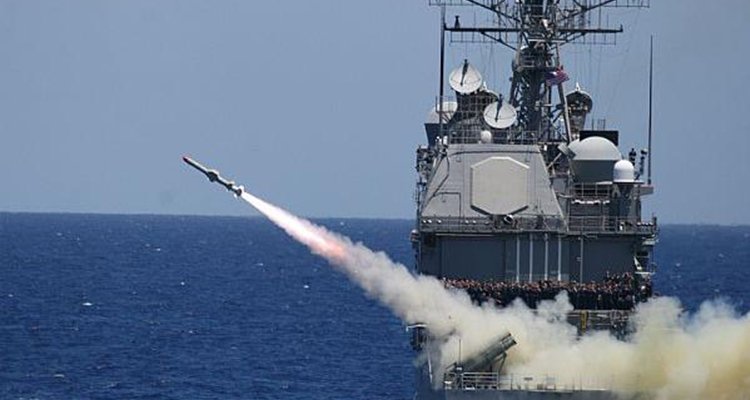
The United States has delivered “the first five Harpoon anti-ship missile launcher vehicles—part of the Harpoon Coastal Defense Systems…along with a radar truck” to Taiwan (Newsweek, June 20, 2025)
In 2020, the Pentagon’s Defense Security Cooperation Agency announced that the U.S. would sell 100 Harpoon Coastal Defense Systems and up to 400 RGM-84L-4 Harpoon Block II surface-launched missiles to Taiwan at an estimated total cost of $2.37 billion.
According to its manufacturer, Boeing, the Harpoon Block II missile is armed with a 500-pound penetrating high-explosive warhead and is capable of striking ships more than 77 miles away. Taiwan is scheduled to receive all of its Harpoon Coastal Defense Systems by 2028.
Not long ago The National Interest published an article wondering whether the harpoon missile is a “Great But Obsolete Weapon?”
After describing the advantages of the missile as it has evolved—including ability to evade radar detection, increasing range, incorporation of GPS guidance—author Brandon Weichert suggests that “the Harpoons, like so many advanced weapons platforms that helped America defeat the Soviets, are now being made obsolete by enemy advances—notably the incredible technological innovations occurring in China.” (This author also believes that the aircraft carrier is becoming obsolete.)
Still, though, “the Harpoon should never be underestimated….”
What about some A-10s?
A former U.S. deputy under secretary of defense, Stephen Bryen, argues that instead of unloading 162 A-10 Warthog aircraft by sending them to an airbase boneyard to “rot away in the sun,” which is the current plan, the U.S. Air Force should instead give them to Taiwan, “where they could make a major contribution to defending the island” (Asia Times, June 30, 2025).
Taiwan’s existing aircraft are unlikely to be able to stop an incoming invasion fleet, or support Taiwanese air defenses by knocking out swarms of drones.
The A-10, however, can do both jobs, and it is more sturdy and survivable than any Taiwan air force jet in the inventory. The A-10 also has superior firepower and is equipped with new weapons ideally suited to sinking an invasion fleet or blasting away at drones….
The new star of the show is the A-10’s ability to fire the new/old 70mm Advanced Precision Kill Weapon System II….
The range of the APKWS is around two miles. Most drones cannot fight back, so knocking them out of the sky is a turkey shoot.
If Taiwan had the full fleet of A-10s, it could focus its air defenses against Chinese missiles and let the A-10s operate against drones.
Bryen concludes that the U.S. has no reason to refrain from giving the A-10s to the ROC. Taiwanese air crews could be quickly trained and the assets needed to maintain the fighters could be quickly transferred. The A-10 “would would hand to Taiwan a capability it sorely lacks, and one that China will fear. With F-16s challenging China’s air arm, the A-10 can sink an invasion fleet and do so quickly.”
Also see:
StoptheCCP.org: “How China’s BDS Is Clobbering America’s GPS”
StoptheCCP.org: “With Red China in Mind, U.S. Marine Corps Makes Terrible Tradeoff”