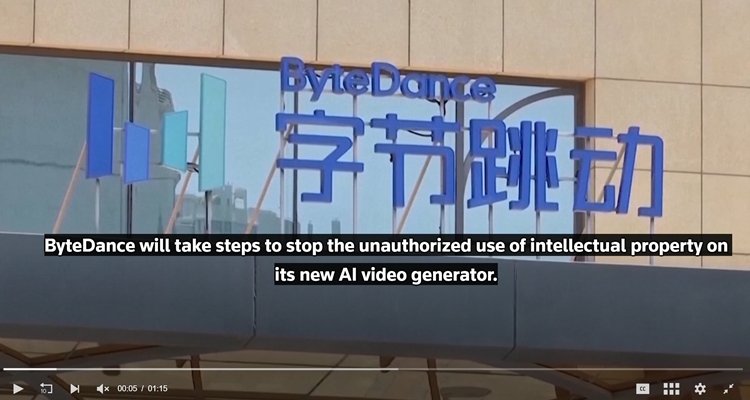
ByteDance is probably not concerned about Disney’s cease-and-desist letter “accusing the Chinese firm of using Disney characters to train and power Seedance 2.0 without permission.” Seedance 2.0 is AI software for generating videos.
“Disney said ByteDance had prepackaged Seedance with a pirated library of copyrighted characters from franchises including Star Wars and Marvel, portraying them as if they were public-domain clip art,” reports Reuters. “The letter alleged Seedance was reproducing, distributing and creating derivative works featuring Spider-Man, Darth Vader, and other characters, the person added” (February 15, 2026).
Paramount Skydance and the Motion Picture Association have also complained about Seedance 2.0’s infringement of copyrights.
Taking steps
ByteDance will be solving this problem, it says. “We are taking steps to strengthen current safeguards as we work to prevent the unauthorized use of intellectual property and likeness by users.”
ByteDance is the China-based company that owns the TikTok app including, now, a fifth of the U.S. version of TikTok.
A year of negotiations and delays ensued after the arrival of a January 2025 deadline by which TikTok was to be shut down in the United States market if ByteDance had not by then sold the U.S. version to U.S. buyers. In consequence of these year-long post-deadline negotiations, the company has half-sold the U.S. version of TikTok to U.S. buyers. ByteDance retains a 20 percent stake for itself—which is not the full divestiture that the law requires.
Ars Technica says that “it remains unclear if the joint venture [that President Trump] arranged with ByteDance and the Chinese government actually resolves Congress’s national security concerns” (January 23, 2026). On the contrary. It is clear that the venture does not resolve the security concerns.
Two former TikTok employees will lead the joint venture. Adam Presser, who previously served as TikTok’s global head of Operations and Trust & Safety, has been named CEO. And Kim Farrell, TikTok’s former global head of Business Operations Protection, will serve as chief security officer….
The law requires the divestment “to end any ‘operational relationship’ between ByteDance and TikTok in the United States,” critics told the NYT. That could be a problem, since TikTok’s release makes it clear that ByteDance will maintain some control over the TikTok US app’s operations.
For example, while the US owners will retrain the algorithm and manage data security, ByteDance owns the algorithm and “will manage global product interoperability and certain commercial activities, including e-commerce, advertising, and marketing.” The Trump administration seemingly agreed to these terms to ensure that the US TikTok isn’t cut off from the rest of the world on the app.
The protections incorporated into the deal—only quasi-compliant at best with the legislation Congress passed a couple of years ago—will be enough, people hope, to protect people in the U.S. from Chinese Communist Party surveillance, propaganda, and data extraction.
A Lark
ByteDance was not persnickety about such things when it had full control of its app. In mid-2024, AP reported that according to U.S. court filings, TikTok and ByteDance “used an internal web-suite system called Lark to enable TikTok employees to speak directly with ByteDance engineers in China. TikTok employees used Lark to send sensitive data about U.S. users, information that has wound up being stored on Chinese servers and accessible to ByteDance employees in China…. Last year, the Wall Street Journal reported TikTok had tracked users who watched LGBTQ content through a dashboard the company said it had since deleted.”
Will the same ByteDance that ignored U.S. security concerns about TikTok before the half-sale of the U.S. version really now be scrupulous about respecting the intellectual property of Disney and other studios merely because ByteDance says that it will? I wouldn’t bet on it.
Also see:
StoptheCCP.org: “TikTok Only Pretends to Hide Data on U.S. Users From ByteDance and China” (April 16, 2024)
“ ‘I literally worked on a project that gave U.S. data to China,’ Turner says.”