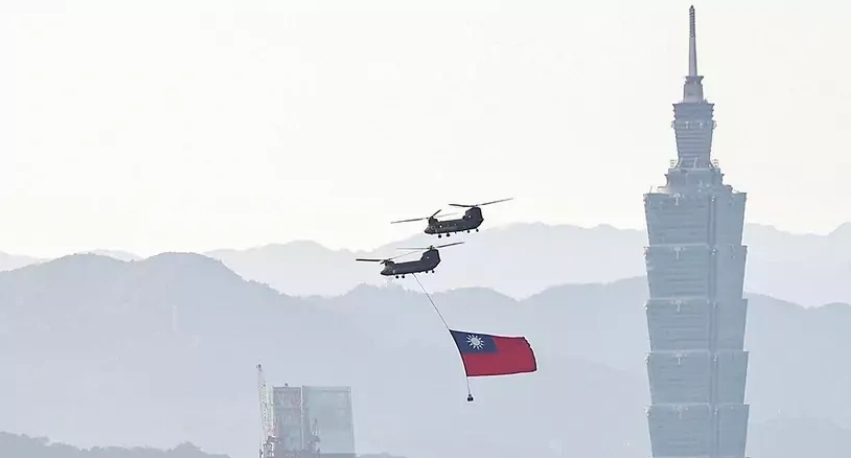
Reuters says: “ ‘Hawkish’ China military squeeze on Taiwan likely after election“ (January 3, 2024).
This does not seem like a hard prediction, since China has never not given Taiwan a hard time.
On the other hand:
While clearly a superior military power, recent purges in the PLA that have felled generals in the Rocket Force, navy and air force and a former defence minister could lower the risk of conflict.
“The more problems they have, the more corruption they have, the better it is for us,” said [Admiral Lee Hsi-ming], the former Taiwan military head. “I don’t think there will be a full-scale invasion in the next few years because they have their own difficulties.”
China has its own difficulties. Okay. Don’t countries sometimes invade other countries even though—and sometimes because—they’re having difficulties? I also wonder whether combating corruption (“corruption” in the sense of unauthorized grift) is the only possible explanation of Xi’s purge of the military.
It’s true that China has been growling at Taiwan for many years without full-scale invading. But the Taiwanese military should not count on a reprieve that the mainland may be counting on it to count on.
Invasion isn’t the only way to beat up Taiwan.
China could also wield economic pressure post-election, targeting a trade deal signed in 2010 which Beijing says Taipei has breached with unfair trade barriers. Beijing could also ramp up operations to influence people in Taiwan through its “United Front” department.
“China needs to be able to lead and control the situation in Taiwan, and we do that via a variety of means, not just by one means,” said Wu Xinbo, a professor at Shanghai’s Fudan University.
One way that China proceeds on all fronts against Taiwan is by encouraging professors at Chinese universities to use the first person plural pronoun when talking about all the ways China has to “lead and control the situation in Taiwan.”
For the last several years, Wu Xinbo has been editing an annual Strategic Report on Sino-U.S. Relations. The reports do not seem to be available in an English translation.
We do have a hint of Wu’s way, though. That he is carefully detached, neutral, and incomplete in his analyses, relating plenty of formal details but none of the bloody ones and saying nothing that might irk his masters, is suggested by a paper he coauthored in the Wu-edited volume East Asian Studies in the Perspective of Regional Integration.
Publishing in 2018, several years after Xi Jinping’s rise to power, Wu Xinbo and Wu Di canvass the history of transitions in the top leadership in China since Mao. They conclude that China’s “political leadership system has its own merits by meeting Chinese current political and social conditions and insuring policy consistency. It also provides opportunities for leaders to get their hands wet as they prepare to lead the country.”
Today, this same guy, Wu Xinbo, is telling us that “we,” he and the Chinese Communist Party, have not just one means but a variety of means of bringing Taiwan to heel.
Also see:
Council on Foreign Relations: “How Taiwan Is Assessing and Responding to Growing Threats From China” (a November 2022 post)
“Despite these growing worries and initial steps, actions remain far below where they need to be to deter China and respond to potential Chinese aggression.”